
Garage Door Keypad Not Working? Reset, Reprogram or Replace
A garage door keypad that stops working is almost always one of four things: a dead 9-volt or coin battery, corroded battery contacts after an Ontario winter, a PIN that was wiped when the opener lost power, or a keypad that has drifted out of pairing with the opener. Fit a fresh battery first, then re-pair the keypad by pressing the LEARN button on the opener head and entering a new PIN within 30 seconds. If the keypad still will not open the door but your remotes do, the keypad itself has failed — a replacement unit is $45 to $90. If nothing opens the door, the fault is the opener’s radio receiver, not the keypad.
- Test your handheld remote first — if that fails too, the problem is the opener, not the keypad.
- A dead battery is the single most common cause; exterior keypads in London go through one roughly every 18 months.
- Losing power at the opener wipes stored PINs on many models — reprogramming takes about 60 seconds.
- A keypad that only works from two feet away has water in the housing or a corroded antenna contact.
- Replacement keypads are $45–$90 and are brand-specific: LiftMaster/Chamberlain, Genie and Overhead Door do not interchange.
First, work out whether it is the keypad or the opener
This is a 20-second test and it saves you from buying the wrong part. Stand in the garage and press your handheld remote. If the door runs, the opener and its radio receiver are fine and the fault is in the keypad or its pairing. If the remote does nothing either, and the wall button inside still works, the opener’s receiver or logic board is the problem — that is an opener repair, not a keypad job, and it is covered in our guide to a remote that has stopped working.
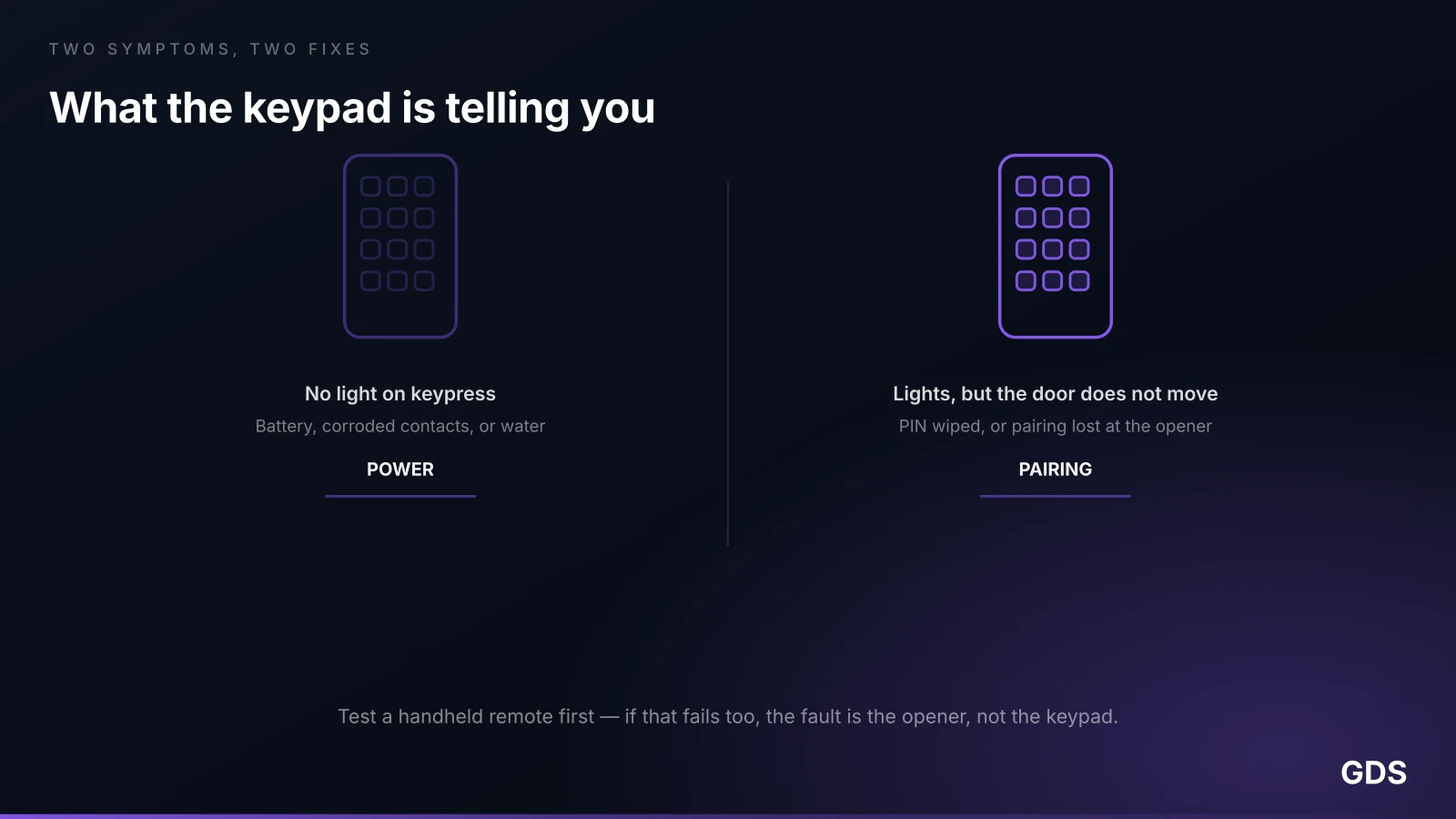
Now look at the keypad itself while you press a key. Almost every model lights the keys or flashes a small LED on any keypress. Nothing at all means no power — a battery, contact or water problem. A light that comes on normally but the door does not move means the keypad has power and is sending, but the opener is not accepting the code: a pairing or PIN problem. Those two symptoms point at completely different fixes, and telling them apart first is what turns this into a ten-minute job.
Change the battery — and clean what the battery was sitting in
Exterior keypads run on a 9-volt block or, on newer slimline units, a pair of CR2032 coin cells. In London’s climate they last around 18 months, and they die faster than the spec sheet suggests because the cold drops the usable voltage before the chemistry is actually spent. A keypad that worked in November and quit in January often has a battery that is only half used.
Slide the cover off — most LiftMaster and Chamberlain units have a hinged flip-up cover with the battery behind it; Genie keypads take a screwdriver at the base. Before the new battery goes in, look hard at the contacts. Green or white powder on the terminals is oxidation, and it is the second most common cause of a dead keypad in Southwestern Ontario. Scrape it back to bright metal with a fingernail file or a pencil eraser, wipe the housing dry, and fit the battery. A smear of dielectric grease on the terminals afterwards is worth doing — it is the difference between a keypad that lasts two winters and one that lasts six.
Press any key. If the keys light up now, go to the next section and reprogram. If they still do not, and the battery is definitely good, the circuit board has taken on water and the keypad needs replacing.
Reprogram the PIN: the sequence nearly every brand uses
Stored PINs are not as permanent as people assume. A power cut, a surge from a summer storm, or a battery pulled out of the opener’s backup unit is enough to wipe the memory on many units — which is why a keypad that has worked for years suddenly rejects a code nobody changed.
The pattern is the same across almost every brand. Find the LEARN or PROGRAM button on the back or side of the opener motor head, usually beside a small coloured LED — you will need a stepladder. Press and release it once; the LED lights and you have roughly 30 seconds. Walk to the keypad, enter the four-digit PIN you want, and press ENTER (on Genie units, press PROGRAM then the PIN then PROGRAM again). The opener clicks or its light flashes to confirm. Test the new PIN before you put the ladder away.
Two things trip people up. Holding the LEARN button down for more than about six seconds erases every remote and keypad paired to the opener rather than adding one — if you do that, you will need to re-pair your handheld remotes too. And on units with a rolling-code security system, entering a wrong PIN repeatedly can lock the keypad out for a minute or two; wait it out rather than pressing harder.
We will tell you in one visit whether it is the keypad, the pairing or the receiver — and fit the right brand-matched unit while we are there.
When the keypad only works from two feet away
A keypad that opens the door when you are standing on top of it but does nothing from the driveway is transmitting weakly. On an exterior unit, that is almost always moisture. Water gets past a cracked cover seal or a cover that was never clipped fully shut, sits on the board, and corrodes the antenna solder joint. The transmitter still works — it just cannot shout.
Two other causes are worth checking before you replace anything. LED bulbs in the opener head are notorious for flooding the same radio band the keypad uses; swapping to a bulb rated as garage-door-opener safe fixes a surprising number of "weak signal" complaints. And on older units, the receiver’s hanging antenna wire is often coiled up, tucked into the housing, or snapped off — it should dangle straight down from the motor head, unwound and untouched.
If the housing is cracked, the fix is a new keypad. Sealing a cracked case with tape or silicone traps the moisture that is already inside and accelerates the corrosion.
Why exterior keypads fail faster in Southwestern Ontario
The keypad is the only part of your opener system that lives outdoors, and it is usually mounted on the jamb where meltwater runs off the door. Between road salt carried in on wind, the freeze-thaw cycles that work moisture past the cover gasket, and direct afternoon sun that makes the rubber keys brittle and cracks them, an exterior keypad in London does harder duty than the same unit in a milder climate.
Three habits stretch its life considerably. Mount it under the drip line rather than directly beneath it, so runoff from the door header is not landing on the cover. Replace the battery on a schedule — every second fall, alongside a tune-up — rather than waiting for it to die at the worst moment. And press the keys with a fingertip rather than a knuckle or a car key; the membrane behind a cracked key is what lets water into the board in the first place.
If your keypad is more than about eight years old and the keys have gone hard and shiny, replacing it proactively is cheaper than the call-out you will otherwise make in February. It is also a good moment to check whether your opener still supports it — pre-1993 units without rolling codes are a security problem regardless of the keypad.
What a replacement keypad costs, and what fits your opener
A replacement wireless keypad is $45 to $90 for the unit, depending on brand and whether you want a backlit or a fingerprint model. They are not universal: a LiftMaster or Chamberlain keypad talks to LiftMaster, Chamberlain, Craftsman and Raynor openers; Genie keypads pair with Genie and Overhead Door units; a keypad for a wall-mount jackshaft opener is different again. Buying on price alone is how people end up with a keypad that will never pair.
If we are already at your home for another job, fitting and pairing a keypad adds no labour. As a standalone visit it falls under opener service, from $189, which also covers the diagnosis if it turns out the receiver is the real fault. Either way we confirm one all-in price before starting, and every part carries a 1-year warranty on parts and labour.
One upgrade worth weighing: if your opener predates rolling-code security, a new keypad does not fix that, and a code grabber can still capture a fixed code from the street. On a unit that old, the money is usually better spent on a new opener — which arrives with a modern keypad, remotes and phone control included. We service keypads and openers across London, Byron, Hyde Park, Masonville, St. Thomas and Woodstock.
Frequently asked questions
Why has my garage door keypad stopped working?
Four causes cover nearly every case: a dead battery, corroded battery contacts, a PIN wiped by a power cut at the opener, or a keypad that has lost its pairing. Test a handheld remote first — if the remote works, the fault is in the keypad; if nothing works, the opener’s receiver is the problem instead.
How do I reset the PIN on my garage door keypad?
Press and release the LEARN button on the opener motor head, then enter your new four-digit PIN on the keypad and press ENTER within about 30 seconds. Genie units use PROGRAM, then the PIN, then PROGRAM again. Do not hold the LEARN button for more than six seconds — that erases every remote and keypad paired to the opener.
What battery does a garage door keypad take?
Most take a single 9-volt block; newer slimline models take one or two CR2032 coin cells. In London they last about 18 months because cold weather drops usable voltage early. Clean any green or white corrosion off the terminals before fitting the new one, and add a smear of dielectric grease.
My keypad only works when I stand right next to it. Why?
That is a weak transmission, and on an exterior keypad it is usually moisture corroding the antenna joint inside a cracked or badly seated cover. Two other culprits are worth ruling out first: LED bulbs in the opener head interfering on the same radio band, and the opener’s hanging antenna wire being coiled up or broken instead of dangling straight down.
How much does a new garage door keypad cost in London, Ontario?
The unit is $45 to $90 depending on brand and whether it is backlit or fingerprint-enabled. Fitting and pairing adds no labour if we are already on site for another job; as a standalone call it falls under opener service from $189, which includes the diagnosis and a 1-year warranty on parts and labour.
Are garage door keypads universal?
No. Keypads are brand-family specific. LiftMaster, Chamberlain, Craftsman and Raynor share one family; Genie and Overhead Door share another; wall-mount jackshaft openers use different units again. Match the keypad to the opener brand and to whether the opener uses rolling codes, or it will never pair.
Related guides
Garage Door Remote Not Working? 9 Fixes Before You Buy a New One
The wall button works but the remote is dead — or it only works from two feet away. The nine causes we actually find on service calls, in the order you should check them.
Garage Door Opener Replacement in London, ON: Best Models for 2026
When a garage door opener is worth replacing in London, the best belt, chain, and wall-mount models for 2026, what installation costs, and which smart features actually matter.
Essential Garage Door Opener Parts You Should Know
Motor, drive, trolley, logic board, safety sensors, remotes — what each opener part actually does, and the ones that fail first.