
Cracked Garage Door Hinge? What the Numbers Mean and What It Costs

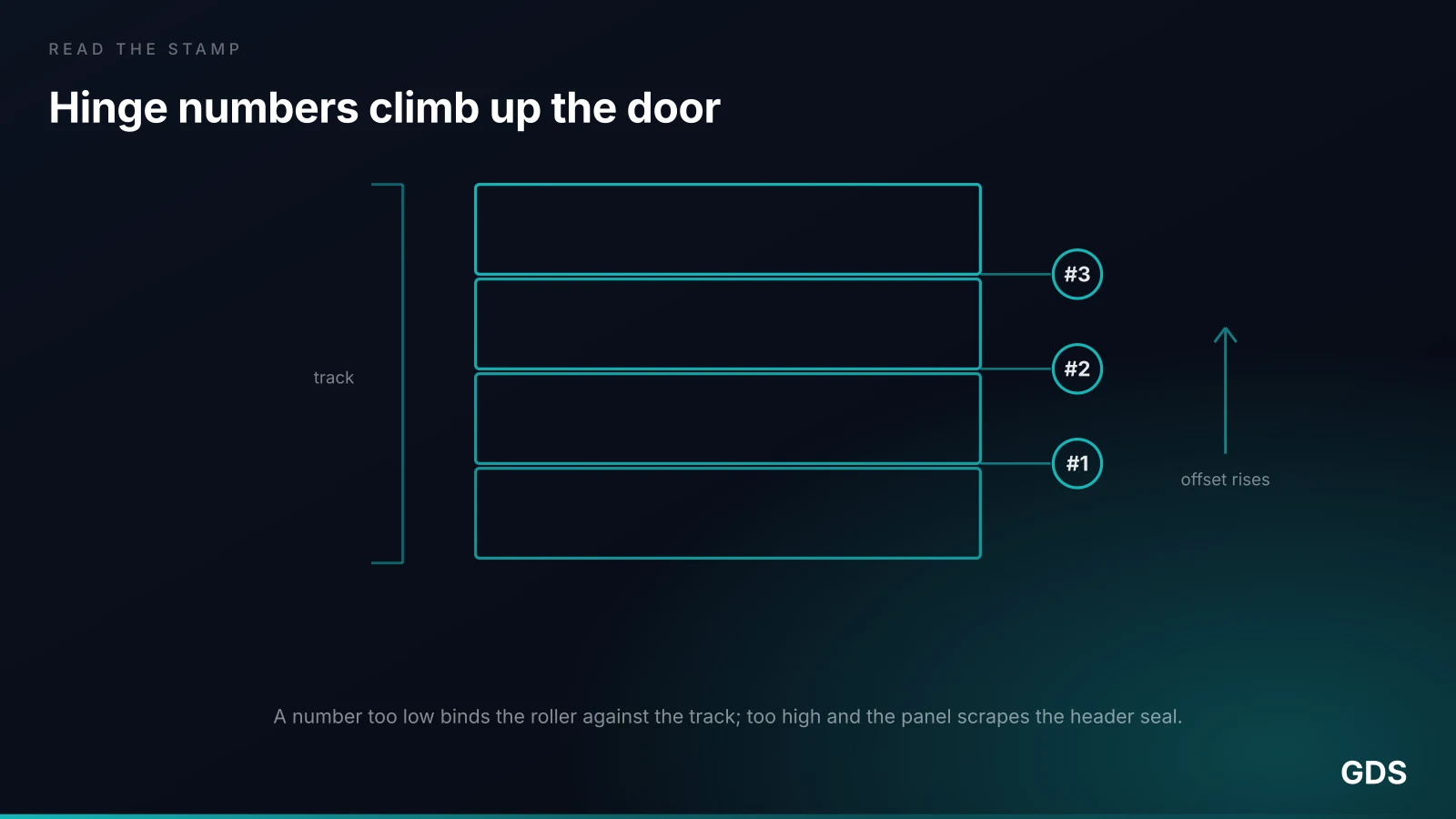
Garage door hinges are numbered 1 through 5 and the number sets how far the roller stem is offset from the door face. A #1 hinge sits between the two lowest panels; the numbers climb as you move up the door, so the panels progressively tuck into the track curve. Fitting the wrong number makes the door bind, rub or run crooked. Replace any hinge that is cracked, bent, rusted through at the knuckle, or has elongated its roller sleeve. In London, Ontario hinge replacement runs $149 to $229 depending on how many are involved, or $10 to $40 as an add-on to a $150 tune-up.
- Hinge numbers set the roller offset — #1 at the bottom joint, rising as you go up the door.
- End hinges (at the track) carry load; centre hinges mostly locate the panels. Both crack, differently.
- A hairline crack at the knuckle spreads fast under cycle load — this is not a "watch it" repair.
- Galvanised 14-gauge hinges outlast the 18-gauge stock fitted on most builder-grade doors.
- The bottom bracket looks like a hinge and is not one. It anchors the lift cable and is never DIY.
The numbers stamped on your hinges are not decoration
Look at the flat face of any hinge on your door and you will find a number stamped into the steel, usually 1 through 5. That number is the roller offset — how far the roller stem sits proud of the door face. It exists because a sectional door does not travel in a straight line. As each panel rounds the curve from the vertical track into the horizontal, it needs to sit slightly further back than the panel below it, or the panels would jam against each other.
So the numbering climbs as you go up the door. The joint between the bottom two panels takes #1 hinges; the next joint up takes #2, then #3, and so on. On a four-panel door you will typically see #1, #2 and #3 in that order. Some manufacturers add a letter — a #11 or a #1B is a variant offset for a specific track radius, not a different number entirely.
The practical consequence: if a hinge gets replaced with the wrong number, the door binds. A number too low pulls the panel in and the roller runs tight against the track flange; a number too high pushes it out and the panel scrapes the header seal. Both show up as a door that is suddenly rougher or noisier than it was, and both are easy to mistake for a track alignment problem.
End hinges and centre hinges do different jobs
Every panel joint has hinges at both ends, where the door meets the track, and one or more in the middle. They look similar and they fail differently. The end hinges carry a roller and therefore carry load — the weight of every panel below them transfers through that hinge into the roller and the track. Centre hinges have no roller; they keep the panels aligned and stop the door flexing across its width.
End hinges usually fail at the roller sleeve. The round tube the roller stem sits in wears oval under years of load, the roller starts to wobble, and eventually the sleeve splits along its seam. Once that happens the roller has room to climb, and a door with a split sleeve is one hard cycle away from coming off its track.
Centre hinges usually fail at the knuckle — the barrel where the two leaves pivot. On a wide double door with only one centre hinge per joint, panel flex works that knuckle every cycle until it cracks. You will often hear it before you see it: a sharp pop or clack at the same point in the door’s travel, every time.
How a cracked hinge fails — and what it takes with it
Hinge cracks are fatigue cracks. They start as a hairline at a stress riser — the corner of a stamped hole, the base of the knuckle — and they grow a little on each of the thousand-odd cycles a door does in a year. This is not a "keep an eye on it" repair. A hinge that is visibly cracked today is measurably more cracked next month.
What makes it worth acting on quickly is what fails next. A hinge that lets go under load drops that corner of the panel; the roller is pulled sideways out of the track, and the door racks. At best you get a derailed door. At worst the panel above creases at the point of load, and a creased panel is a panel replacement rather than a $20 part.
Rust is the other route to failure, and Ontario is hard on hinges for a specific reason: salt-laden slush drips off the car onto the garage floor, evaporates, and the resulting damp salty air sits inside an unheated garage all winter. Builder-grade 18-gauge hinges rust from the inside of the knuckle outward, so the first sign is often stiffness and a rust bloom at the pivot rather than obvious corrosion on the face.
We match the stamped numbers to your door, fit 14-gauge galvanised stock, and rebalance and safety-test before we leave.
Replacing a hinge — and the one you must never unbolt
A centre hinge on a closed door is one of the genuinely approachable repairs on a garage door. With the door fully closed and the opener unplugged, the panels are resting on the floor and the hinge is not under load; four lag screws or carriage bolts come out, the new hinge goes on with the same number stamped on it, and the fasteners are torqued back down. Work one hinge at a time.
End hinges are a step harder because the roller has to come out of the track and the hinge is carrying panel weight even when the door is closed. Done wrong, the panel corner drops. It is doable, but it is the point where most homeowners are better off calling.
The one that is never a DIY job is the bottom bracket. It sits at the lower corner of the bottom panel, it looks like an oversized end hinge, and it is the anchor point for the lift cable. With the torsion spring wound, that bracket is holding the entire weight of the door through a cable under extreme tension. Unbolting one is a recognised cause of serious injury in this trade. If the part you want to replace has a cable attached to it, stop.
What hinge replacement costs in London, Ontario
A hinge itself is a $6 to $20 part. What you are paying for is the visit, the correct numbers matched to your door, and the balance and safety check afterwards. In London and the surrounding 50 km, a standalone call to replace one or several hinges runs $149 to $229 all-in, parts and labour, with a 1-year warranty. Added to a $150 tune-up the same work typically adds $10 to $40, because the technician is already on the ladder with the hardware inspection done.
If more than two or three hinges have cracked, we will usually recommend doing all of them at once and stepping up to 14-gauge galvanised stock. The parts cost difference across a door is small, the labour is identical, and it removes the whole failure mode for the remaining life of the door. Doors that have had a derailment are the other case for a full replacement — hinges bend in that event even when they do not visibly crack.
Worth checking at the same visit: hinges and rollers wear together, because a wobbling roller is what elongates a hinge sleeve in the first place. Replacing one without inspecting the other tends to bring you back. We service doors across London, Old North, Masonville, Byron, St. Thomas and Aylmer.
Frequently asked questions
What do the numbers on garage door hinges mean?
The stamped number is the roller offset — how far the roller stem sits proud of the door face. #1 hinges go at the joint between the two lowest panels, and the number climbs as you move up the door so each panel can tuck into the track curve. Fitting the wrong number makes the door bind or rub.
Can I replace a garage door hinge myself?
A centre hinge on a fully closed door with the opener unplugged is approachable — it is not under load, and it is four fasteners. End hinges carry panel weight and are harder. The bottom bracket, which looks like an oversized hinge, must never be unbolted: it anchors the lift cable under full spring tension.
How much does garage door hinge replacement cost in London, Ontario?
A standalone visit to replace one or several hinges runs $149 to $229 all-in with parts, labour and a 1-year warranty. Added to a $150 tune-up while the technician is already on site, the same work typically adds $10 to $40. The hinge itself is only a $6 to $20 part — the visit and the follow-up safety check are the value.
What happens if a garage door hinge breaks?
The corner it supports drops, the roller is pulled sideways out of the track, and the door racks. That usually means a derailed door, and often a creased panel above the failure point — which turns a $20 part into a panel replacement. Cracked hinges are fatigue cracks and they grow every cycle, so they are not a wait-and-see repair.
How long do garage door hinges last?
Builder-grade 18-gauge hinges commonly last 10 to 15 years in Ontario before rust at the knuckle or an elongated roller sleeve ends them. Heavier 14-gauge galvanised hinges typically outlast the door. Salt carried in on the car and left to sit in an unheated garage is what shortens the cheap ones.
Should I replace all the hinges at once?
If more than two or three have cracked, yes — the parts cost across a whole door is small, the labour is the same visit, and stepping up to 14-gauge galvanised removes the failure mode for the door’s remaining life. A door that has come off its track is the other case, because hinges bend in a derailment even when they do not visibly crack.
Related guides
Garage Door Roller Replacement: Nylon vs Steel, and What It Costs
Ten small wheels carry the whole door. When their bearings give out the door gets loud, drags on the tracks and starts eating opener gears — here is how to read them and what replacing them costs.
Garage Door Off Its Track? Stop — Do This First (London, ON)
A crooked door hanging off one track is the most dangerous call we get. What to do in the first five minutes, what the repair costs, and why DIY re-seating usually ends in a bigger bill.
Backed Into Your Garage Door? Panel Replacement Cost in London (2026)
It happens more than you’d think — a bumper, a basketball, a hailstorm. What a single panel costs to replace in 2026, when a dent can be repaired, and when the math favours a new door.