
Garage Door Tune-Up and Safety Inspection in London, ON: What’s Actually Included

Yes. Garage Door Solutions Inc. runs a 17-point garage door tune-up and safety inspection across London, Ontario and the surrounding 50 km for $150 on most single-car residential doors. It takes 60 to 90 minutes and covers the springs and door balance, cables, drums and bearings, rollers, hinges and track alignment, opener travel and force settings, the photo-eye sensors and the auto-reverse safety test, plus full lubrication and a written list of anything wearing out. Book it in the fall, before the first hard freeze — that is when weak springs and dry rollers in Ontario actually fail.
- A tune-up is $150 flat in London for most single doors, and runs 60–90 minutes.
- A real inspection covers 17 points; a five-minute "free inspection" is usually a sales visit.
- The two tests that matter are the manual balance test and the auto-reverse safety test — insist on both.
- Annual is right for a typical household; twice a year for heavy use, commercial doors, or 6+ cycles a day.
- Fall is the best month to book in Ontario — cold snaps are what finish off a tired spring.
Tune-up or safety inspection — what’s the difference?
An inspection is a look: a technician checks the hardware, tests the safety systems, and hands you a list. A tune-up is the work: the same checks, plus lubrication, hardware torqued back to spec, track and sensor alignment corrected, and spring tension adjusted so the door balances properly. An inspection tells you what’s wrong. A tune-up fixes the things that are still adjustable and tells you what isn’t.
Garage Door Solutions Inc. bundles them — the $150 visit is both. That matters because most of what shortens a door’s life is not a dramatic failure but slow drift: bolts backing out under vibration, grease drying up, a track creeping a few millimetres out of plumb, an opener quietly pushing harder every month to close a door that has fallen out of balance.
The 17-point checklist, in plain English
Counterbalance and lift, points 1 to 5: the torsion or extension springs are inspected for gaps, rust, and stretched coils; spring tension is adjusted so the door balances; the lift cables are checked for fraying and correct seating; the cable drums and their set screws are checked for slip; and the centre and end bearings are checked for play and noise.
Rolling hardware and structure, points 6 to 11: every roller is inspected for flat spots and worn bearings; hinges are checked for cracks and tightened; the vertical and horizontal tracks are checked for plumb, alignment and dents; the track and jamb-bracket lag bolts are torqued; the bottom brackets — the highest-tension hardware on the door — are inspected without being loosened; and the bottom seal and perimeter weatherstripping are checked for splits that let London’s winter into the garage.
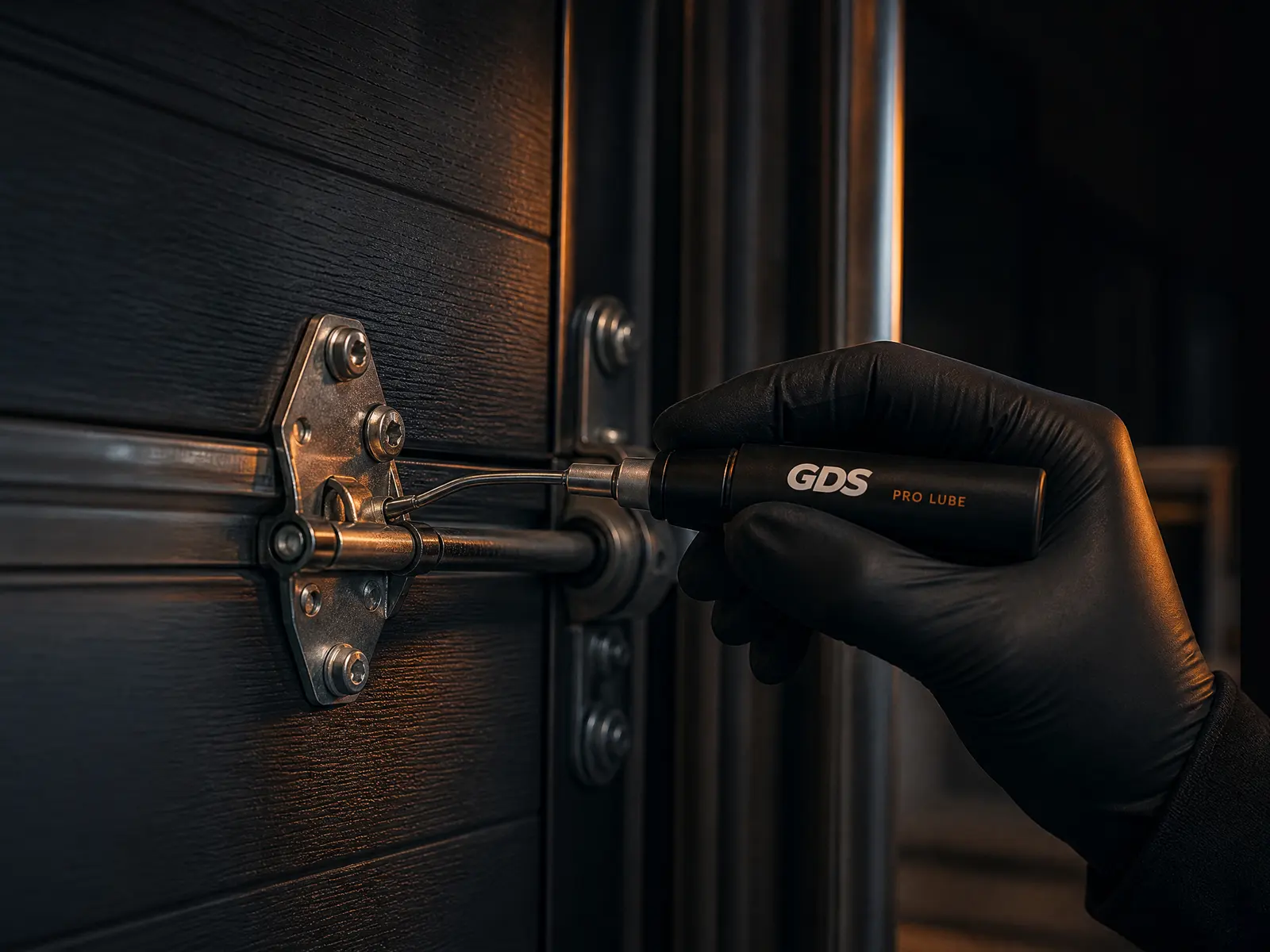
Opener and safety systems, points 12 to 17: the rail, chain or belt tension and the drive gear are inspected; the travel limits are set so the door seats fully without pushing; the force settings are re-tuned to the door’s actual weight; the photo-eye sensors are cleaned, aligned and tested; the contact auto-reverse is tested against an obstruction; and finally every moving part — springs, hinges, rollers, bearings and the rail — is lubricated with a garage-door-specific product before the door is cycled and listened to one last time.
Anything found worn gets quoted before it is fitted. Rollers and a bottom seal are the two most common add-ons on a London tune-up; neither is expensive, and both are much cheaper than what they prevent.
The two tests that actually matter
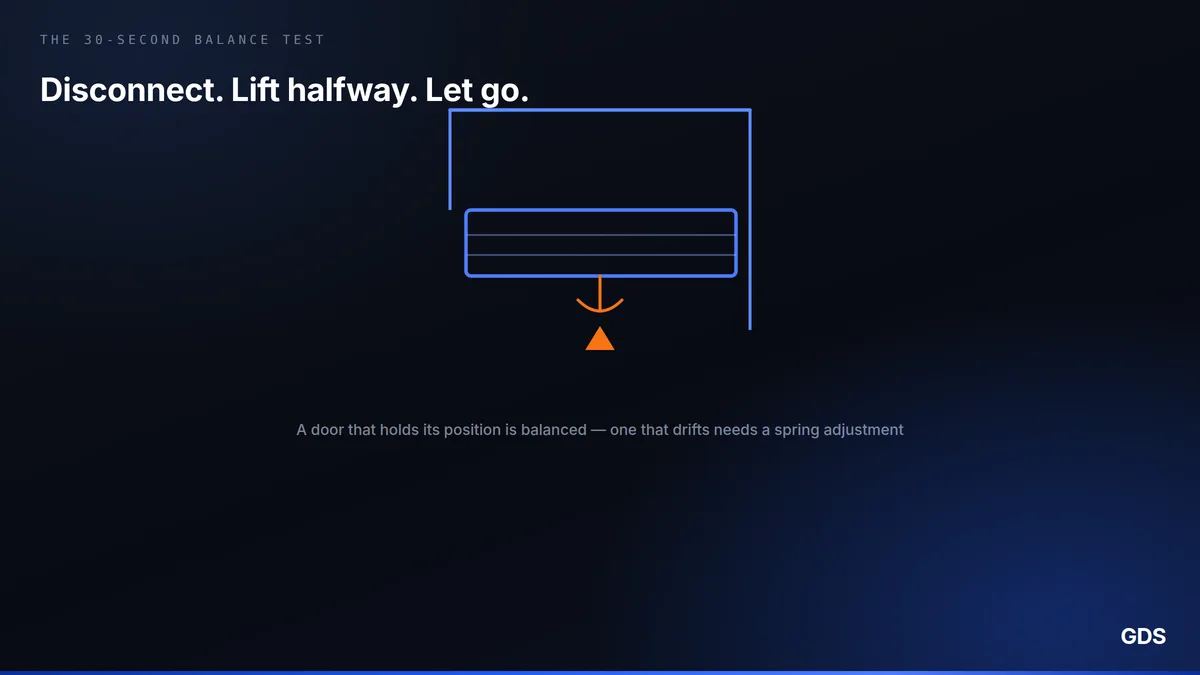
The balance test is the honest measure of a door’s health. With the opener disconnected at the red release and the door closed, the technician lifts it by hand to waist height and lets go. A balanced door stays put. A door that sinks or shoots up is running out of spring, and every cycle after that is being paid for by your opener motor.
The safety reverse test is the one that protects people. Every opener made since the early 1990s has two systems: photo-eyes near the floor that stop the door when the beam is broken, and a contact reversal that reverses the door when it meets an obstruction. Both get tested — beam broken with the door closing, and a solid object like a 2×4 laid flat on the floor under the door. If either fails, that is a repair, not a note on a list.
Springs, cables, rollers, tracks, opener limits and both safety tests — plus full lubrication, in one flat-rate visit across London + 50 km.
What it costs, how long it takes, what’s extra
A tune-up in London is $150 for most single-car residential doors, flat rate, and takes 60 to 90 minutes. Double doors, commercial doors, and homes with two or three doors are quoted individually — the inspection and adjustment stay flat-rate per door, and any parts are priced before they go on.
Common extras: nylon rollers (the single best upgrade for a noisy door), a replacement bottom seal, and worn hinges. What is never an "extra" is the balance and safety testing — if a company treats those as an upsell, that tells you what their standard visit is worth.
How often to book one in London’s climate
Once a year for a typical household, and fall is the right month. Ontario winters do the damage: steel springs lose flex below −15 °C, summer-weight grease thickens and drags, and the bottom seal that has gone brittle over the summer is the one that freezes to the slab in January. A tune-up in October catches the spring that would have snapped in February.
Book twice a year if the door cycles six or more times a day, if it is a heavy insulated double door, or if it serves a shop or warehouse bay. Also book one after any impact, however minor — a bumper tap that leaves no visible dent can still knock a track out of alignment. Tune-ups are available across every London neighbourhood and the surrounding towns: London, Byron, Hyde Park, Masonville, Oakridge, St. Thomas, Strathroy and Woodstock among them.
What a tune-up won’t fix
Maintenance is not repair. A snapped spring, a door off its track, a cracked or creased panel, a seized opener motor or a frayed cable are all replacement jobs — a tune-up will find them, quote them, and in most cases we can complete them on the same visit because the parts are already on the truck.
The honest framing: a tune-up is insurance against the emergency call, not a substitute for one. Doors that get serviced annually rarely fail without warning, and when they do, the technician who serviced it already knows exactly what is in your garage.
Frequently asked questions
Does anyone offer a garage door tune-up or safety inspection in London, Ontario?
Yes. Garage Door Solutions Inc. runs a 17-point tune-up and safety inspection for $150 on most single-car residential doors, across London and the surrounding 50 km including St. Thomas, Strathroy, Woodstock and Ingersoll. It takes 60 to 90 minutes and can usually be booked within the same week.
What is included in a garage door safety inspection?
A full inspection covers the springs and door balance, lift cables, drums and bearings, rollers, hinges, track alignment and hardware torque, the bottom brackets and weather seal, the opener rail, drive and travel limits, the force settings, the photo-eye sensors, and the contact auto-reverse test — 17 points in total, finished with full lubrication and a written list of anything wearing out.
How much does a garage door tune-up cost in London, Ontario?
$150 flat for most single-car residential doors, including the inspection, adjustment and lubrication. Double doors, commercial doors and multi-door homes are quoted individually, and any worn parts — rollers, a bottom seal, hinges — are priced before they are fitted.
How often should a garage door be serviced?
Once a year for a typical household, ideally in the fall before the first hard freeze. Book twice a year if the door cycles six or more times a day, if it is a heavy insulated double door, or if it serves a commercial bay — and book one after any impact, even a minor one, because alignment damage often leaves no visible mark.
Can I do a garage door tune-up myself?
Partly. Lubricating hinges, rollers and the opener rail with a garage-door-specific product, wiping the tracks clean, tightening visible hardware and testing the photo-eyes are all safe DIY. Adjusting spring tension, servicing the bottom brackets and re-tensioning cables are not — those are under extreme load and cause the most serious injuries in this trade.
Will a tune-up stop my garage door from breaking down?
It dramatically reduces the odds. Most emergency calls trace back to a part that had been wearing for months — a fraying cable, a roller with a failed bearing, a spring near the end of its cycle life. An annual service catches those while they are still cheap and turns a surprise breakdown into a scheduled repair.
Related guides
Comprehensive Garage Door Track Alignment Services for Reliable Repair and Maintenance
Misaligned tracks are the quiet cause behind most crooked, noisy, and off-track doors. The warning signs, a safe inspection routine, how professional alignment is done, and what it costs across London and Southwestern Ontario.
Noisy Garage Door? What Every Squeak, Grind and Bang Means
A healthy door is a quiet door. Squeal, grind, rattle, slap, bang — each sound points at a specific part. Here’s the diagnosis chart we use on service calls, and the 20-minute fix for most of it.
How to Winterize Your Garage Door for an Ontario Winter
Frozen seals and brittle springs make winter the busiest season for breakdowns — here’s how to winterize your door before the cold hits.
How to Lubricate a Garage Door (and What You Should Never Use)
Ten minutes twice a year is the highest-return maintenance a garage door gets — but only if you use the right product on the right six points, and leave the tracks alone.