
Garage Door Roller Replacement: Nylon vs Steel, and What It Costs

Garage door rollers should be replaced when they wobble on their stems, show flat spots, seize instead of spinning, or the door has become noticeably louder and rougher on the tracks. Most residential doors carry ten rollers and they are replaced as a full set, because the ones you cannot see have done the same number of cycles as the ones you can. Sealed 13-ball nylon rollers are the upgrade worth paying for: they run far quieter than steel, need no lubrication, and last 10 to 15 years. In London, Ontario a full set fitted runs $179 to $280, or roughly $20 to $60 as an add-on to a $150 tune-up.
- A typical residential door has ten rollers — eight on the panels plus two top fixtures.
- Spin each roller by hand with the door closed: a good one turns freely and does not rock on its stem.
- Nylon rollers with 13 sealed ball bearings are quieter, need no grease, and outlast steel by years.
- Rollers are replaced as a set — mixing a new roller into nine worn ones just moves the noise.
- The bottom roller sits in the bottom bracket, which is under full cable tension. That one is never DIY.
What a garage door roller actually does
Each roller is a small wheel on a steel stem. The stem slots into a hinge or bracket on the door panel; the wheel rides inside the track. Ten of them — typically four hinges a side plus the two top fixtures on a standard sectional door — are what let a 150 to 400 lb door change direction from vertical to horizontal without binding.
They are also the quietest-failing part on the whole assembly. A spring snaps with a bang; a cable frays visibly. A roller just gets gradually worse over thousands of cycles until the door is loud, slow, and dragging its panels against the track flanges. By then the wear has usually spread — to the hinges the stems sit in, to the track the wheel has been scraping, and to the opener that has been pushing against the extra friction.
The four signs your rollers are finished
Noise is the first and the most reliable. A door that has developed a grinding, scraping or rumbling sound as it travels — rather than a squeak, which is usually dry hinges — is running on rollers whose bearings have broken down. Our guide to what every garage door sound means separates the roller noises from the opener ones.
Wobble is the second. With the door fully closed, take hold of a roller and try to rock it. A healthy roller has almost no play on its stem. One that tips several millimetres has a worn bearing race, and it is letting the door move laterally in the track every cycle.
Flat spots are the third, and they are specific to steel rollers. A steel wheel that has seized stops rolling and starts sliding, which grinds a flat onto one side. Once a roller has a flat you can feel a rhythmic bump as the door travels — and the flat spot is now machining the inside of your track.
The fourth is a door that no longer runs square. If one side of the door reaches the header before the other, or the door drifts toward one track, worn rollers are one of the usual suspects, alongside a stretched cable or a balance problem.
Nylon vs steel — and why the bearing count matters
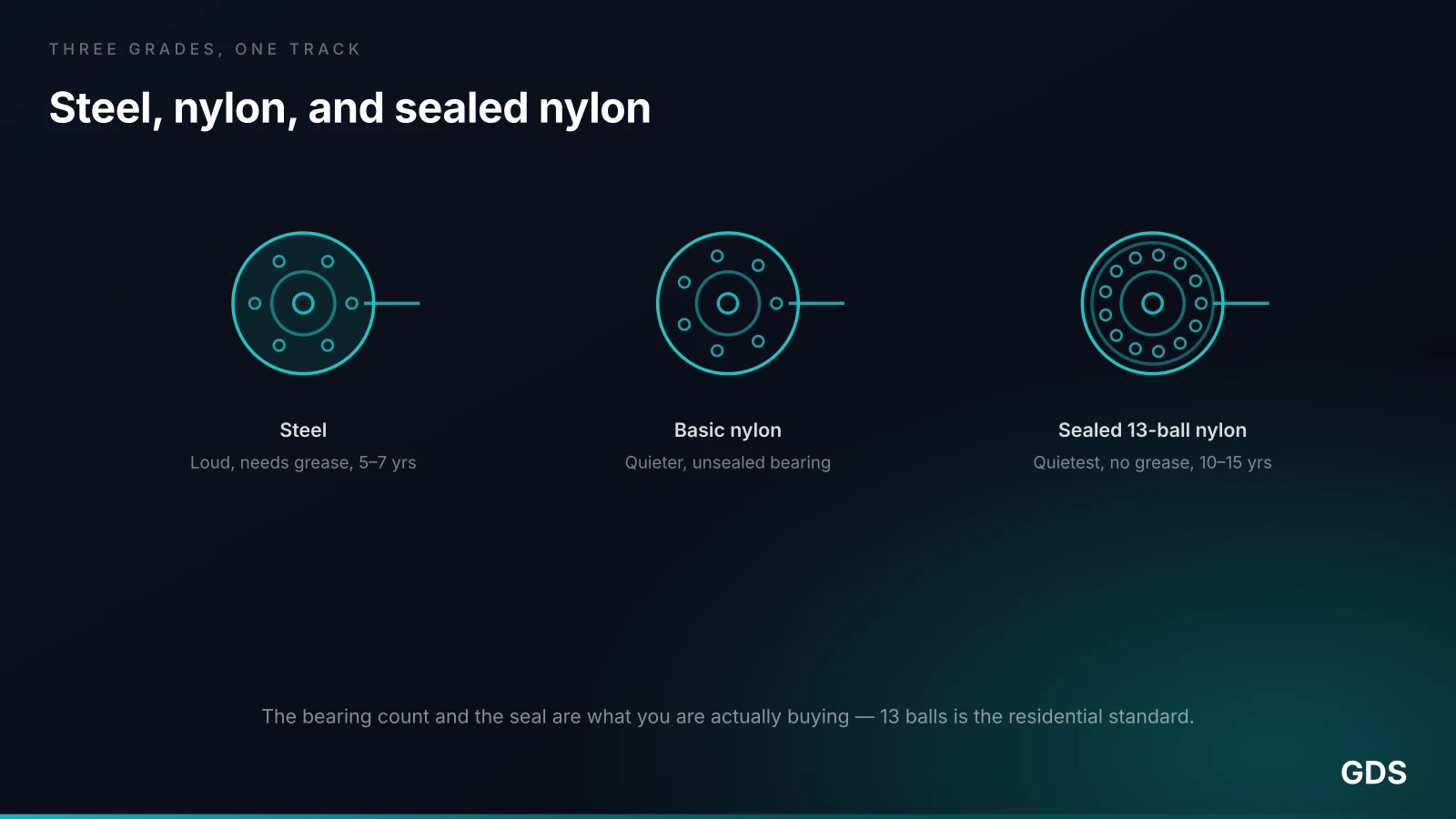
Steel rollers are what most builders fit because they are the cheapest thing that works. They are loud, they need periodic lubrication at the bearing, and in an unheated Ontario garage the grease in a cheap steel roller thickens enough in January that the wheel stops turning and starts sliding. Their advantage is load capacity, which is why they still make sense on heavy commercial doors.
Nylon rollers replace the steel wheel with a moulded nylon tyre on a steel stem. They run dramatically quieter because nylon against steel track does not ring the way steel on steel does, and the good ones are sealed so grit and salt cannot get into the bearing. The number that matters on the packaging is the bearing count: a 7-ball roller is an entry-level part, an 11-ball is decent, and a 13-ball sealed nylon roller is what we fit as standard. Expect 10 to 15 years from a sealed 13-ball set on a normally used residential door.
The upgrade is also the single most cost-effective noise fix available. If a door has kept the family above the garage awake for years, a set of nylon rollers changes that in under an hour — more reliably than any amount of lubrication, because lubrication cannot restore a collapsed bearing.
A sealed nylon roller set, full lubrication, hardware retorqued and both safety tests — in one visit across London + 50 km.
Why rollers are replaced as a set of ten
Every roller on your door has done the same number of cycles. If one has failed after 12 years, the other nine are 12 years old too — they are simply failing in a slightly different order. Replacing the one that is loudest today buys you a few months before the next one takes over, and it means paying the call-out twice.
There is a mechanical argument as well. A door running on nine worn rollers and one new one does not track evenly; the new roller carries a different amount of the lateral load and wears faster than it should. Sets are also cheap relative to the labour — the parts for a full residential set are a small share of the visit, which is why fitting one roller rarely makes financial sense.
The exception is a door that has just come off its track. There, one or two rollers may have been damaged in an otherwise healthy set, and replacing just the casualties while re-seating the door is reasonable — we will tell you which case you are in before quoting. Either way it is the same visit as our cable and track repair service, which is where roller work is priced.
Can you replace garage door rollers yourself?
Partly, and the line matters. The intermediate rollers — the ones in the hinges between panels — can be changed by a competent DIYer with the door closed, by loosening the hinge, tipping the old roller stem out of its sleeve and the wheel out of the track, and reversing the process. Work one at a time so the door never loses more than one point of location.
The two you must not touch are the bottom rollers. Each sits in the bottom bracket at the corner of the lowest panel, and that bracket is the anchor point for the lift cable — it carries the full weight of the door through a spring under extreme tension. Unbolting it with the springs wound is how people are seriously injured in this trade. The same caution applies to the top fixtures on a door with the opener attached.
Honestly assessed, a full set is a 45-to-60-minute job for a technician with the right stem lengths on the truck, and it is usually bundled into a tune-up where the balance and safety tests get redone afterwards. That last part is what most DIY roller swaps skip, and it is the part that matters.
What roller replacement costs in London, Ontario
A full set of ten sealed nylon rollers fitted runs $179 to $280 in London and the surrounding 50 km, parts and labour included, with a 1-year warranty. The spread reflects door size, stem length, and whether the visit also needs hinges or a track section straightened. As an add-on during a $150 tune-up, the same set typically adds $20 to $60 because the labour is already on site — which is the cheapest way to buy them.
Set against what worn rollers cause, that is inexpensive. Rollers that bind put lateral load into the tracks, which is one of the routes to a track alignment job or, at the far end, a derailed door in the $179 to $400 band. They also make the opener work harder every cycle, and opener gear sets are not cheap.
We carry roller stock on every truck, so this is almost always a first-visit fix across London, Oakridge, White Oaks, Lambeth, Strathroy and Ingersoll.
Frequently asked questions
How do I know if my garage door rollers need replacing?
Four signs: the door has become loud and grinding rather than just squeaky, a roller rocks noticeably on its stem when you try to wobble it, a steel roller has a flat spot you can feel as a rhythmic bump, or the door has started running out of square in the tracks. With the door closed, each roller should spin freely by hand with almost no side play.
How much does garage door roller replacement cost in London, Ontario?
A full set of ten sealed nylon rollers fitted runs $179 to $280 including parts, labour and a 1-year warranty. Added to a $150 tune-up while the technician is already on site, the same set typically adds $20 to $60 — the cheapest way to buy them.
Are nylon garage door rollers better than steel?
For residential doors, yes. Nylon runs far quieter than steel on a steel track, sealed models keep grit and road salt out of the bearing, and they need no lubrication. Look for 13 ball bearings and a sealed race; expect 10 to 15 years. Steel still makes sense on heavy commercial doors where load capacity outranks noise.
How long do garage door rollers last?
Basic steel rollers typically last 5 to 7 years on a door cycled a few times a day. Sealed 13-ball nylon rollers last 10 to 15 years in the same service. Ontario winters shorten both — thickened grease and road salt are what finish a cheap roller early.
Can I replace garage door rollers myself?
The intermediate rollers in the panel hinges can be changed one at a time by a careful DIYer with the door closed. The bottom rollers cannot: they sit in the bottom brackets, which anchor the lift cables and carry the full spring tension. Unbolting a bottom bracket with the springs wound causes some of the worst injuries in this trade.
Should all garage door rollers be replaced at once?
Yes, in almost every case. All ten have done the same number of cycles, so the survivors are simply failing in a different order. A single new roller in a worn set also carries an uneven share of the lateral load and wears out early. The exception is a door that just came off its track, where one or two may be the only casualties.
Related guides
Noisy Garage Door? What Every Squeak, Grind and Bang Means
A healthy door is a quiet door. Squeal, grind, rattle, slap, bang — each sound points at a specific part. Here’s the diagnosis chart we use on service calls, and the 20-minute fix for most of it.
Cracked Garage Door Hinge? What the Numbers Mean and What It Costs
The numbers stamped on your hinges are not decoration — put a #2 where a #4 belongs and the door binds. How to read them, spot a cracked hinge early, and know which one to never unbolt.
Garage Door Tune-Up and Safety Inspection in London, ON: What’s Actually Included
What a real tune-up covers versus a five-minute "inspection", the 17 points we actually check, what it costs in London, and why fall is the right month to book it.