
Are Insulated Garage Doors Worth It in Ontario? R-Value, Comfort & Cost

For most Ontario homes — especially with an attached garage, a bedroom above it, or any workshop use — yes, an insulated garage door is worth it. Aim for R-12 to R-18 with a proper thermal break and perimeter seals; that keeps a London garage roughly 10–12°C warmer than outside in winter, takes real load off your furnace, and gets you a stiffer, quieter door. Skip the upgrade only for a detached, unheated garage you treat purely as parking.
- For Ontario winters, R-12–R-18 is the sweet spot; beyond R-18 the returns get thin.
- An insulated door keeps an unheated attached garage roughly 10–12°C warmer than outdoors.
- Polyurethane injection insulates about twice as well as polystyrene sheets at the same thickness.
- A door’s R-value is meaningless without a thermal break and good perimeter seals — ask about both.
- Insulated doors are also stiffer (fewer dents, less sag) and noticeably quieter — the underrated half of the upgrade.
What R-value actually tells you
R-value measures resistance to heat flow — higher is better. A single-skin steel door is effectively R-0: in January it’s a 7-by-16-foot radiator pointed the wrong way. Insulated residential doors run from about R-6 (thin polystyrene) to R-18+ (thick injected polyurethane).
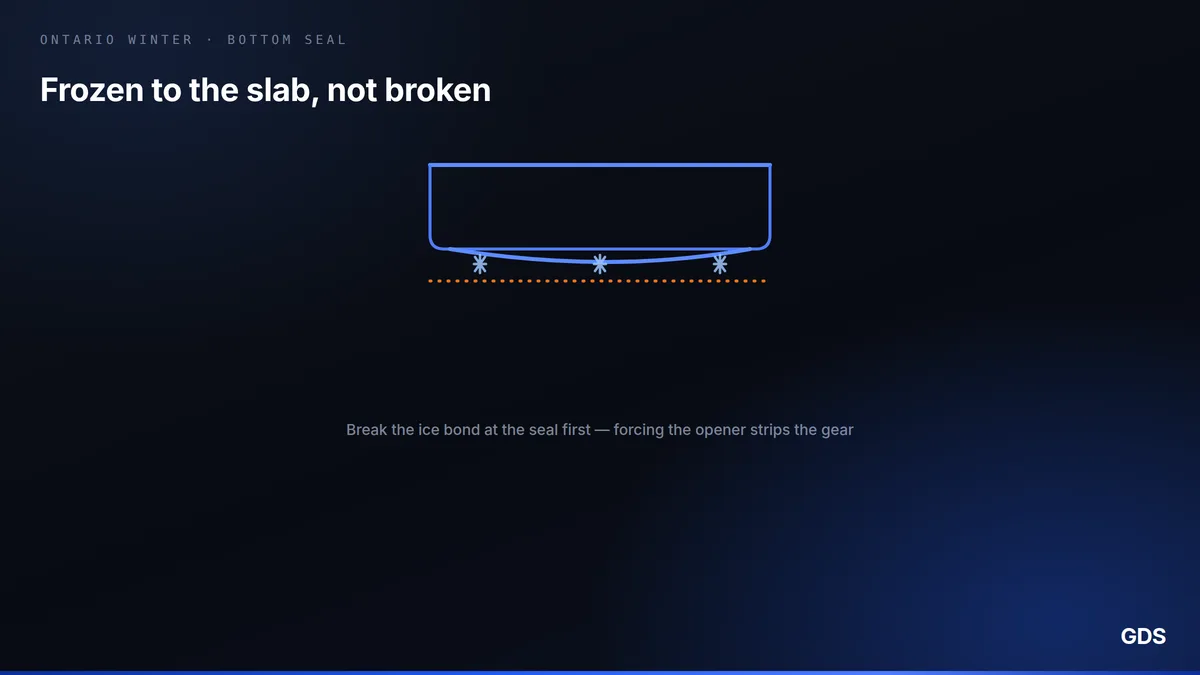
Two caveats the brochures skip. First, the printed number describes the panel centre, not the whole door — real-world performance is lower. Second, R-value only counts conduction; if cold air pours through gaps around the door, the foam never gets a vote. A door with an honest thermal break (an insulating barrier between outer and inner steel skins) and fresh perimeter and bottom seals will outperform a higher-R door without them.
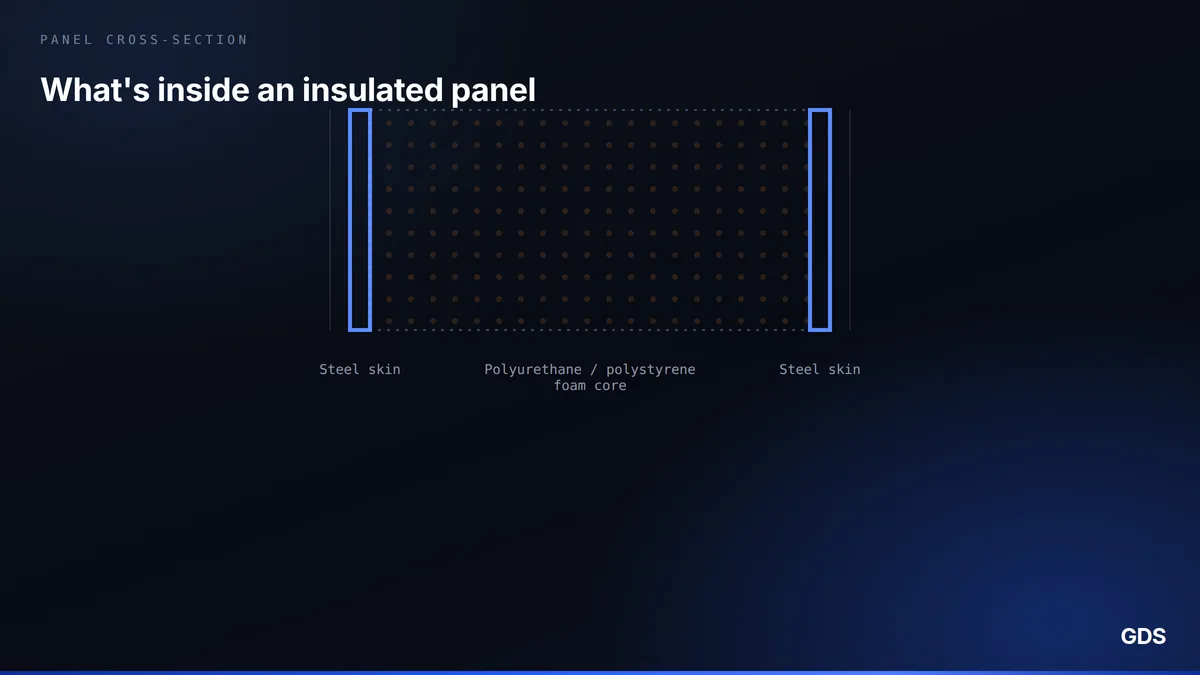
Polyurethane vs polystyrene
Polystyrene is the rigid white sheet foam, cut and fitted inside the panel — economical, decent, typically R-6 to R-9. Polyurethane is foamed in place under pressure: it bonds to both skins, fills every void, and delivers roughly double the R-value at the same thickness — R-12 to R-18.
The injection bonding is why polyurethane doors also feel like different machinery: the foam turns each panel into a stiff sandwich that resists dents, sag, and the panel "oil-canning" rattle. For premium looks or big double doors, polyurethane construction is most of what you’re paying for.
What you’ll actually feel (and save) in a London winter
With an insulated door, a typical unheated attached garage in London holds around 10–12°C above the outside temperature. On a −15°C night that’s the difference between a freezer and a fridge: the car starts happier, the freezer in the garage stops overworking, and the door itself — springs, opener grease, weather seal — lives an easier life.
The furnace savings are real but honest people quote them modestly: every wall the garage shares with the house, and especially a bedroom over the garage, stops bleeding heat into a cold buffer zone. Homes with heated garages see the fastest payback — heating a garage behind an uninsulated door is burning money. For most attached-garage homes, think "noticeably warmer rooms and a modestly smaller gas bill," compounding every winter for the 20+ year life of the door.
R-12 to R-18 doors from Clopay, Garaga, and CHI — measured, quoted, and installed by our own techs across London + 50 km. Free quote, no pressure.
The cost difference — and who should skip it
The insulation premium is smaller than most people expect: on a standard double door, stepping from a non-insulated to a mid-range insulated model typically adds a few hundred dollars, well within our new door installs from $1,499. Because the labour, springs, and tracks cost the same either way, the marginal dollars all go into the panel itself — which is why we fit insulated doors on the large majority of London installations.
Who can skip it? A detached, unheated garage used purely for parking gains little beyond the stiffer panels — spend the money elsewhere. And if your current insulated door is underperforming, check the seals and door balance before blaming the foam; a $150 tune-up fixes more "cold garage" complaints than a new door does.
Frequently asked questions
What R-value garage door do I need in Ontario?
R-12 to R-18 is the sweet spot for Ontario winters — enough to hold an attached garage 10–12°C above the outside temperature. Below R-10 you’ll feel it in January; beyond R-18 the extra money buys very little for a residential garage.
How much warmer does an insulated garage door keep the garage?
Roughly 10–12°C above the outdoor temperature in an unheated attached garage, assuming the door has a thermal break and decent perimeter seals. In a heated garage, the same door dramatically cuts what you spend keeping it warm.
Is polyurethane or polystyrene garage door insulation better?
Polyurethane. It’s injected under pressure, bonds to both steel skins, and insulates about twice as well as polystyrene sheets at the same thickness (R-12–R-18 vs R-6–R-9) — and the bonding makes the panels stiffer and quieter too.
Is an insulated garage door worth it for a detached garage?
Usually not for pure parking — there’s no shared wall with the house, so the energy case mostly disappears. If you heat the space or use it as a workshop, insulation becomes worth it again.
Related guides
How Much Does a New Garage Door Cost in London, Ontario? (2026)
Real 2026 installed prices for a new garage door in London — by material, size, insulation, and the add-ons that move the number.
How to Winterize Your Garage Door for an Ontario Winter
Frozen seals and brittle springs make winter the busiest season for breakdowns — here’s how to winterize your door before the cold hits.
New Garage Door Installation in London, Ontario: A Buyer’s Guide
What a new garage door install actually involves in London — the free measure, choosing material and insulation, the install day, and what to expect on price.
Garage Door Bottom Seal and Weather Seal Replacement in London
Four different seals close the gaps around a garage door, and they fail in different ways. How to tell which one has gone, how to match a bottom seal to its retainer, and what replacement costs.