
Grinding Overhead? Garage Door Bearings and Cable Drums Explained

A grinding, squealing or rhythmic rumbling noise coming from the shaft above a garage door is usually a failed bearing — either one of the two end bearing plates at the sides or the centre bearing at the spring anchor. A cable drum failure shows differently: the door starts closing crooked, one cable goes slack, and you may see the cable riding off its grooves. Both are torsion-system repairs, because the springs must be unwound before the shaft can come out. In London, Ontario bearing or drum replacement runs $229 to $400 and is normally a same-day, single-visit job.
- Three bearings carry the torsion shaft: two end bearing plates and one centre bearing at the anchor bracket.
- Bearing noise comes from overhead and rises with door speed — opener noise comes from the motor head.
- A slipping or cracked cable drum makes the door close crooked and puts one cable slack.
- Both repairs require unwinding the torsion springs first — this is never a DIY job.
- Bearings are worth replacing preventively during a spring change: the labour is already paid for.
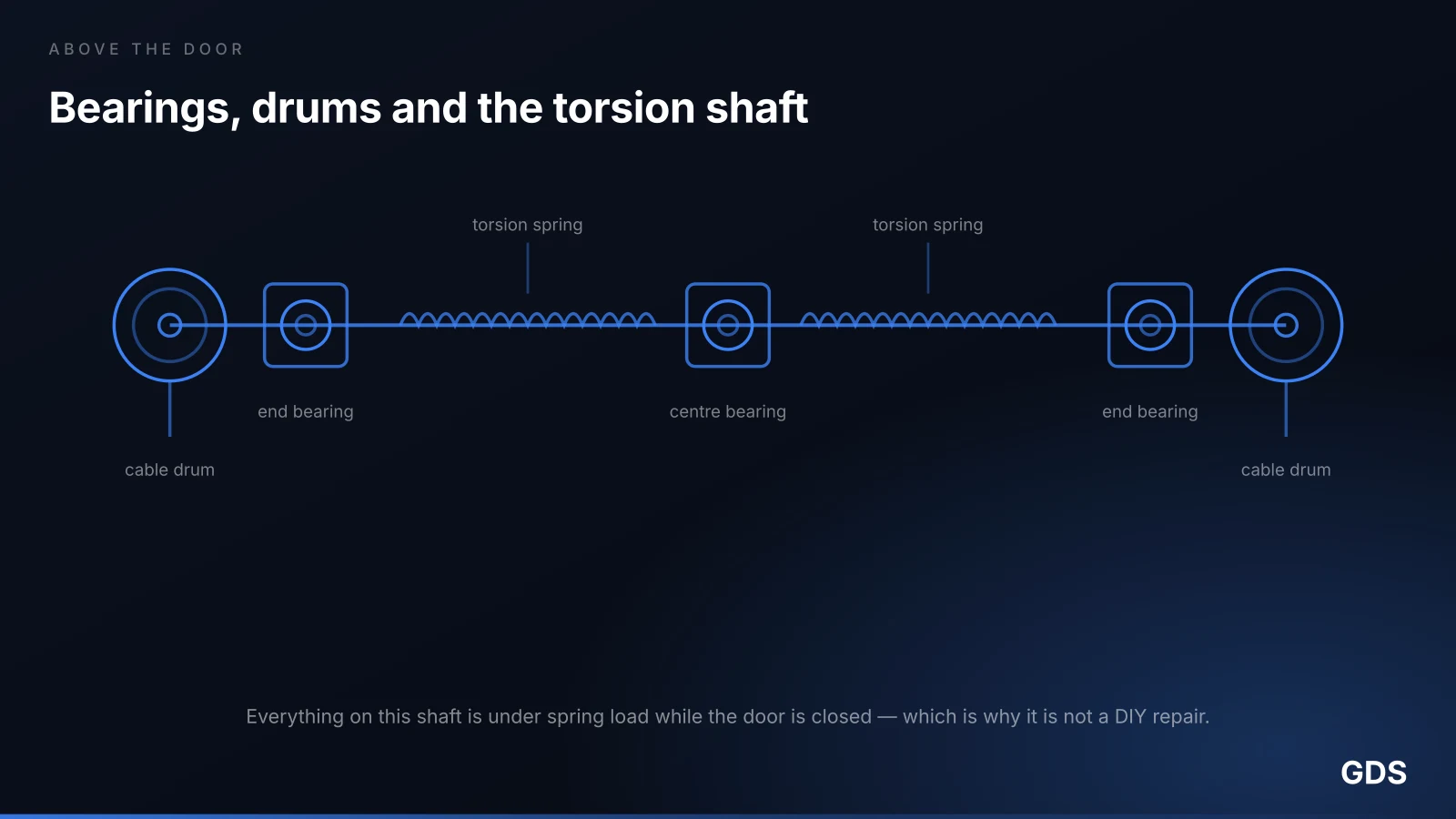
The three bearings and two drums above your door
Above a torsion-spring door runs a steel shaft, usually 1 inch or 1 ¼ inch, spanning the full width of the opening. It carries the springs, and at each end it carries a cable drum — a grooved aluminium or cast wheel that the lift cable winds onto as the door rises. That is the whole counterbalance system: the springs store energy, the shaft transmits it, the drums convert rotation into cable travel, and the cables lift the door.
The shaft has to rotate, so it runs in bearings. There are three on a standard single-spring or dual-spring setup: an end bearing plate bolted to the wall at each side of the opening, and a centre bearing pressed into the spring anchor bracket in the middle. On a wide double door with two springs, the centre bearing sits between them.
Everything in that assembly is under load whenever the door is closed, because that is when the springs are fully wound. This is the reason bearing and drum work is a different category of job from replacing a roller or a hinge: the shaft cannot come out until the springs are unwound, and unwinding a torsion spring incorrectly is the single most dangerous thing a person can do to a garage door.
What a failing bearing sounds like — and why it is not the opener
A dry or collapsing bearing makes a metallic squeal or a grinding rumble, and there are three tells that separate it from opener noise. First, location: the sound comes from the shaft above the door, not from the motor head further back on the ceiling. Second, timing: it rises and falls with door speed and continues even when the door is moved by hand with the opener disconnected. Third, character: it is a continuous grinding rather than the rhythmic slap of a loose chain or the hum-then-grind of a stripped opener gear. Our noise diagnostic guide covers the full set of sounds if you are unsure which you have.
The reliable test is the manual one. Pull the red emergency release with the door fully closed, then lift the door by hand. If the grinding is still there with the opener out of the loop entirely, the noise is mechanical — bearings, drums, rollers or the springs themselves.
Do not let a bearing run to destruction. When a bearing seizes, the shaft starts wearing directly against the bearing plate or, worse, the shaft begins to gall and score. At that point you are replacing the shaft as well as the bearing, which roughly doubles the parts and adds significantly to the labour.
When a cable drum slips: the crooked-door symptom
Cable drums fail in two ways, and neither of them sounds like a bearing. The first is a set screw that has backed off — the drum is clamped to the shaft by two set screws, and if one loosens the drum slips relative to the shaft. That side of the door then stops lifting in sync with the other, so the door closes visibly crooked and one lift cable goes slack while the other stays taut.
The second is a cracked or worn drum. Aluminium drums crack at the hub or wear their grooves smooth, and once the grooves are worn the cable no longer seats — it rides up over the previous wrap and then drops, which you will notice as a sudden jerk in the door’s travel and, over a short period, a rapidly fraying cable.
A slack cable on a closed door is a stop-using-it signal. The door is no longer being lifted evenly, the panels are being racked every cycle, and a cable that jumps its drum entirely can let one side of the door drop. If you see a loose cable or a door that closes with one corner ahead of the other, unplug the opener and call. Running it "just a few more times" is how a drum problem becomes an off-track door over a car.
Bearings, drums, cables and springs are one system. We unwind it safely, replace what failed, and rebalance the door before we leave.
Why bearing and drum work is torsion work
The sequence is fixed. The springs are unwound with winding bars — properly sized steel bars in the winding cone, never screwdrivers — until all stored energy is out of the system. The door is secured. The set screws on the drums are released, the shaft is drawn out of the end bearing plates, and the failed component comes off. The new bearing is fitted, the drums are reset, the cables are seated with equal tension on both sides, the springs are rewound to the calculated turn count for the door’s weight, and the door is rebalanced and safety-tested.
That is roughly a 60-to-90-minute job for a technician who does it regularly, and it is the same skill set as a spring replacement. It is also why every guide including ours says the same thing about torsion springs: the stored energy in a wound spring is measured in hundreds of foot-pounds, and it releases in a fraction of a second when something goes wrong. Our guide to why spring work is a pro job spells out the mechanics.
The practical takeaway for homeowners is a scheduling one. If your springs are near the end of their cycle life and a bearing has started to sing, do both on the same visit. The unwinding, the shaft removal and the rewinding — the bulk of the labour — are shared between the two jobs.
What bearing and drum replacement costs in London
Bearing or drum replacement in London and the surrounding 50 km runs $229 to $400 all-in, parts and labour, with a 1-year warranty. The parts themselves are modest — a sealed end bearing plate is $20 to $45, a centre bearing $15 to $35, a cable drum $30 to $70 — and the price is dominated by the torsion work around them. A door that needs new cables at the same time, or a shaft that has been scored by a seized bearing, sits at the upper end.
Because the labour overlaps so heavily, replacing bearings preventively during a spring change is the value play. Adding a set of sealed bearings to a spring job you were paying for anyway typically costs $40 to $90 more, versus a separate $229-plus visit in two years when the bearing finally goes.
These are same-day repairs — the trucks carry bearings, drums and cable — and emergency dispatch starts at $149 at the same flat rate day or night, with no after-hours surcharge and no travel fee inside 50 km. We reach most calls in London proper inside 45 minutes and across the wider service area inside 90 minutes, covering London, Hyde Park, Oakridge, Lambeth, Woodstock and Ingersoll.
Frequently asked questions
Why is my garage door making a grinding noise from above?
A continuous metallic grinding or squeal from the shaft above the door is usually a dry or collapsing bearing — one of the two end bearing plates or the centre bearing at the spring anchor. Confirm it by pulling the red release and moving the door by hand: if the noise persists with the opener disconnected, it is mechanical, not the motor.
What does a garage door cable drum do?
The drum is a grooved wheel clamped to each end of the torsion shaft. As the springs turn the shaft, the lift cable winds onto the drum and raises that side of the door. If a drum’s set screws loosen or its grooves wear smooth, that side stops lifting in sync — the door closes crooked and one cable goes slack.
How much does garage door bearing replacement cost in London, Ontario?
Bearing or cable drum replacement runs $229 to $400 all-in with parts, labour and a 1-year warranty. The parts are inexpensive — $15 to $70 each — and the price reflects the torsion work: the springs must be unwound and the shaft removed before anything can be changed.
Can I replace a garage door bearing myself?
No. The bearings sit on the torsion shaft, and the shaft cannot be removed until the springs are fully unwound with proper winding bars. A wound torsion spring stores hundreds of foot-pounds of energy that releases in a fraction of a second if it is mishandled. This is the same risk category as a spring replacement.
Should I replace bearings when I replace the springs?
It is usually the smart call. The unwinding, shaft removal and rewinding are the bulk of the labour and they are shared between both jobs. Adding sealed bearings to a spring replacement typically costs $40 to $90 more, versus a separate $229-plus visit when the bearing fails on its own a year or two later.
Is a slack garage door cable dangerous?
Yes — stop using the door. A slack cable means one side is no longer being lifted evenly, the panels are being racked every cycle, and a cable that jumps its drum entirely can let one corner of the door drop. Unplug the opener and book service rather than running the door a few more times.
Related guides
Garage Door Cable Repair in London, ON: A Safety Guide
A frayed or snapped cable can drop a door or send it off-track. Why cables fail, why it’s not a DIY fix, and what professional cable repair costs in London.
Noisy Garage Door? What Every Squeak, Grind and Bang Means
A healthy door is a quiet door. Squeal, grind, rattle, slap, bang — each sound points at a specific part. Here’s the diagnosis chart we use on service calls, and the 20-minute fix for most of it.
Broken Garage Door Spring in London: Signs and What to Do
A loud bang and a door that won’t budge usually means a snapped spring. Why you shouldn’t run the door, how same-day matched-pair replacement works, and what it costs.