
Garage Door Won’t Stay Open? That Is a Balance Problem
A garage door that will not stay open — it sinks or slams shut when you let go — is out of balance, which means the springs are no longer carrying the door’s weight. Confirm it with the balance test: pull the red emergency release with the door closed, lift the door by hand to waist height, and let go. A balanced door stays put within an inch or two. A door that sinks has weak or undersized springs; a door that shoots up has too much tension. In London, Ontario a balance adjustment is part of the $150 tune-up, and if the springs have lost their rating, spring replacement starts at $229.
- The balance test takes five minutes and needs no tools: release, lift to waist height, let go.
- A door that sinks is losing spring force; a door that rises on its own has too much.
- A falling door is a safety issue first — never leave it partly open with people or cars underneath.
- Out-of-balance doors quietly destroy opener gear sets, because the motor is now lifting the door.
- Spring tension adjustment is torsion work: winding bars, calculated turn counts, never a DIY job.
Run the balance test before you touch anything
Everything below depends on the result of one test, and it takes five minutes with no tools. Close the door fully. Unplug the opener, then pull the red emergency release cord — this disconnects the trolley so the door moves independently of the motor. Now lift the door by hand to about waist height and let go, keeping your feet clear.
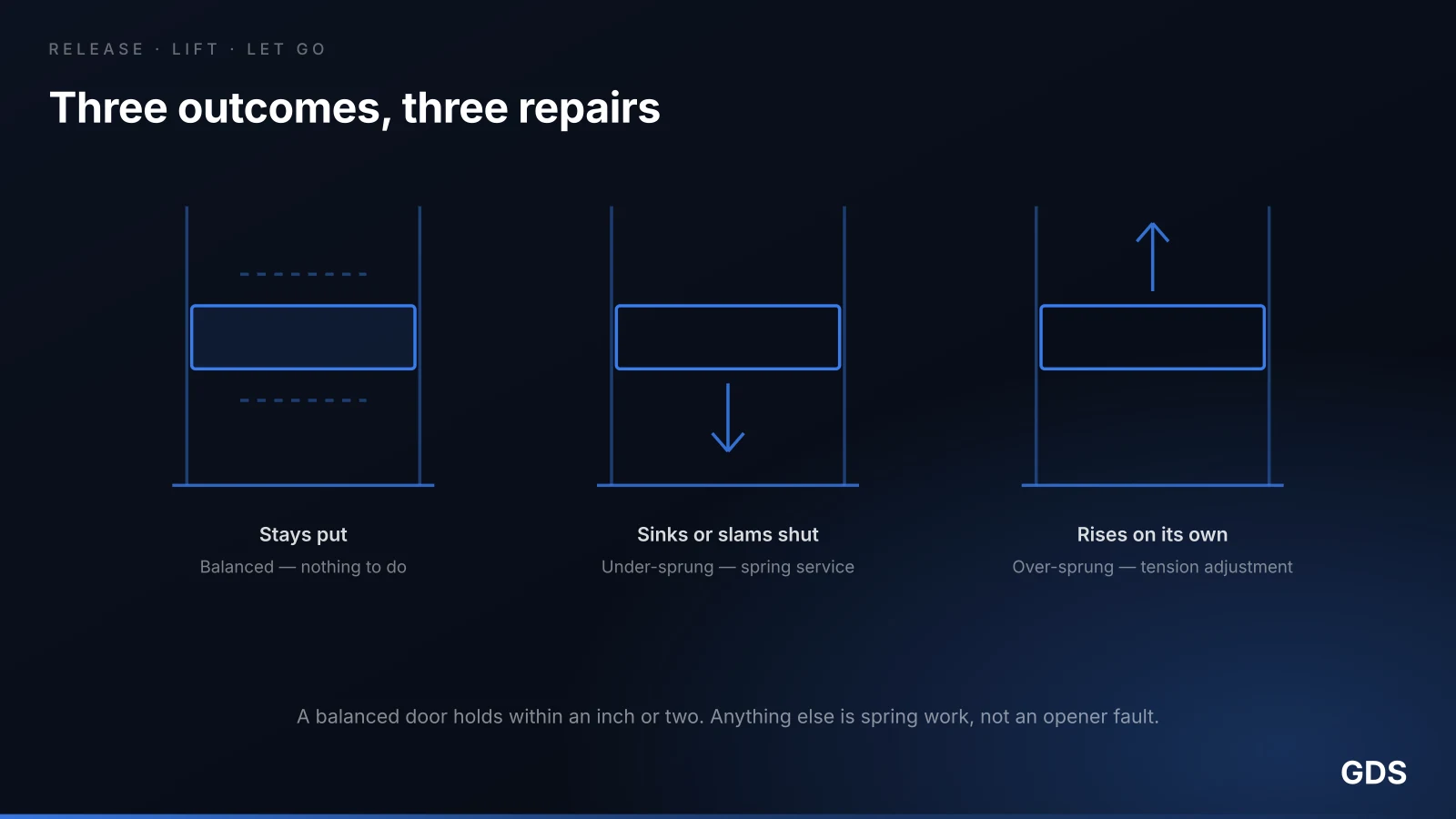
A correctly balanced door stays where you put it, drifting no more than an inch or two either way. It should also feel light: a 150 lb door that is properly counterbalanced lifts with roughly 8 to 10 lb of effort. If you are straining, the springs are already not doing their job.
A door that sinks or accelerates shut is under-sprung. A door that pulls out of your hands and rises on its own is over-sprung. A door that feels heavy in one spot and light in another, or that twists as it moves, has an uneven problem — a broken spring on a dual-spring setup, or a cable drum that has slipped. Note which one you have and stop there; reconnecting the opener to a door that will not hold position is what causes the expensive damage.
What "out of balance" actually means
A garage door is not lifted by its opener. It is counterbalanced by its springs, which are wound to store almost exactly as much energy as it takes to raise the door’s weight. Get that right and the door is effectively weightless in your hands; the opener only has to overcome friction and provide direction. That is why a ½ HP motor can move a 400 lb double door.
Springs are rated in cycles — one open and one close is a cycle — and a standard torsion spring is rated for around 10,000 of them, roughly 7 to 10 years for an average household. What people misread is how a spring reaches the end of that life. It does not hold full force until the day it snaps. It loses force gradually across its last few thousand cycles, which is exactly the period during which the door starts sagging shut, the opener starts sounding strained, and nobody connects the two.
The other route to poor balance is a door that was never right. Adding an insulated kit, swapping to a heavier door, or fitting glass panels without recalculating the spring changes the weight the springs were sized for. So does a replacement spring chosen by eye rather than by wire size, inside diameter and length. Our guide to torsion and extension springs covers how the sizing actually works.
Why a falling door is an opener problem waiting to happen
When the springs stop carrying the load, the load does not disappear — it transfers to the opener. The motor is now genuinely lifting a large fraction of the door’s weight on every cycle, which it was never designed to do. Chain-drive gear sets are the first casualty: the nylon main gear strips, and you get the classic symptom of a motor that hums while nothing moves. That is a repair starting at $189, and on an older unit it often tips the maths toward a new opener instead.
The safety side matters more. An unbalanced door held only by the opener is one failure away from dropping. If the trolley, the chain or the gear lets go, there is nothing counterbalancing the door and it comes down under its own weight. This is why every technician runs the balance test and the auto-reverse test as a pair — the auto-reverse protects against a door closing onto something, and balance is what stops it falling in the first place.
The practical rule while you are waiting for service: do not leave the door partly open, do not park under it, and do not let anyone stand in the opening. If the door will not stay up, close it and use the side door until it is fixed.
We weigh the door, set the spring tension to match, clear the friction, and run both safety tests — same-day across London + 50 km.
The four causes of a door that will not stay open
Weak or end-of-life springs are the most common by a wide margin. The door sinks evenly, feels heavy throughout its travel, and the symptom has crept in over months. On a dual-spring door, one spring that has snapped produces the same sinking but with a visible gap in one coil — that is a spring replacement, and it is a same-day job.
Undersized or mismatched springs are the second: a door that has never held position since a previous repair, or since a heavier door or an insulation kit went on. The fix is not more turns on the existing spring — it is the correctly rated spring for the door’s actual weight, which we determine by weighing the door.
Stretched or unevenly wound cables are the third. If one cable has stretched, the drums are no longer delivering equal lift and the door hangs slightly askew, which reads as both a balance and a tracking problem. That is usually found alongside cable wear.
Friction is the fourth and the one people overlook. A door dragging on binding rollers, out-of-plumb tracks, or dry bearings can mask a balance problem in one direction and exaggerate it in the other. That is why a proper diagnosis clears the friction first, then measures the balance, rather than reaching straight for the winding bars.
Why spring tension is not a DIY adjustment
Adjusting balance means changing spring tension, and on a torsion system that means putting winding bars into the cones of a spring that is already holding several hundred foot-pounds of stored energy. The bars must be correctly sized to the cone, both set screws must be handled in the right order, and the turn count must be calculated for the door — a quarter-turn either way is the difference between right and wrong. When something slips, it releases in a fraction of a second at head height. This is the single most common source of serious injury in the trade, which is why we say plainly that spring work is a pro job.
Extension-spring doors are no safer to adjust despite looking simpler. The springs run along the horizontal tracks under tension whenever the door is closed, and adjusting the S-hook position on a door that has not been fully opened and blocked is how those springs become projectiles. If your door has extension springs without containment cables running through them, that is a separate safety fix worth booking on its own.
What you can safely do is everything that is not the springs: clear the tracks, lubricate the moving parts, tighten visible hardware with the door closed, and rerun the balance test afterwards. If the door still will not hold position once friction is out of the picture, the springs need a technician.
What a balance adjustment costs in London, Ontario
Balance adjustment is part of the 17-point tune-up at $150 — spring tension set for the door’s actual weight, hardware retorqued, cables checked for even tension, full lubrication, and both the balance and auto-reverse tests run before we leave. For a door that is simply drifting out of adjustment, that is the whole repair.
If the springs have lost their rating or one has snapped, adjustment will not bring the door back and spring replacement starts at $229, replaced in matched pairs so the door stays balanced as the second spring ages. Where the balance problem traces to cables or drums instead, cable and track work starts at $179. We confirm one all-in price before starting, so the diagnosis never turns into an open-ended bill.
A door that will not stay open is also a legitimate same-day call, because it is a safety issue rather than an inconvenience. Emergency dispatch starts at $149 at the same flat rate day or night, and we reach most London calls inside 45 minutes and the wider service area inside 90 minutes — London, Masonville, Hyde Park, Oakridge, Woodstock and Ingersoll included.
Frequently asked questions
Why does my garage door not stay open?
Because the springs are no longer counterbalancing its weight. Springs lose force gradually across the last few thousand cycles of their life, so the door starts sinking months before anything snaps. Confirm it with the balance test — release the opener, lift the door to waist height, let go. A balanced door stays put; one that sinks needs spring service.
How do I test if my garage door is balanced?
Close the door, unplug the opener and pull the red emergency release. Lift the door by hand to waist height and let go, keeping clear of it. A correctly balanced door holds position within an inch or two and lifts with about 8 to 10 lb of effort. Sinking means under-sprung; rising on its own means over-sprung.
Is it dangerous if my garage door falls shut on its own?
Yes. An unbalanced door is being held by the opener rather than by its springs, and if the trolley, chain or gear fails there is nothing counterbalancing it. Do not leave it partly open, do not park underneath it, and do not let anyone stand in the opening. Close it and use the side door until it is repaired.
Can I adjust the garage door spring tension myself?
No. Adjusting torsion tension means putting winding bars into a spring holding several hundred foot-pounds of stored energy, with a turn count calculated for the door’s weight. It is the leading cause of serious injury in this trade. You can safely clear the tracks, lubricate, and tighten hardware with the door closed — everything except the springs.
How much does a garage door balance adjustment cost in London, Ontario?
Balance adjustment is included in the $150 17-point tune-up, along with hardware torque, cable checks, lubrication and both safety tests. If the springs have lost their rating, spring replacement starts at $229 in matched pairs; if the cause is cables or drums, cable and track work starts at $179. One all-in price is confirmed before work begins.
Will an out-of-balance garage door damage the opener?
Yes, and it is the most common hidden cost. Once the springs stop carrying the load, the motor lifts a large fraction of the door’s weight every cycle. Chain-drive nylon main gears strip first — the motor hums and nothing moves. That repair starts at $189, and on an older opener it often makes replacement the better spend.
Related guides
Broken Garage Door Spring in London: Signs and What to Do
A loud bang and a door that won’t budge usually means a snapped spring. Why you shouldn’t run the door, how same-day matched-pair replacement works, and what it costs.
Garage Door Stuck Halfway in London, ON: Safety First
A door that stops halfway is telling you something — an obstruction, a broken cable or spring, or misaligned sensors. What’s safe to check yourself, and when to call.
Garage Door Tune-Up and Safety Inspection in London, ON: What’s Actually Included
What a real tune-up covers versus a five-minute "inspection", the 17 points we actually check, what it costs in London, and why fall is the right month to book it.