
How to Lubricate a Garage Door (and What You Should Never Use)

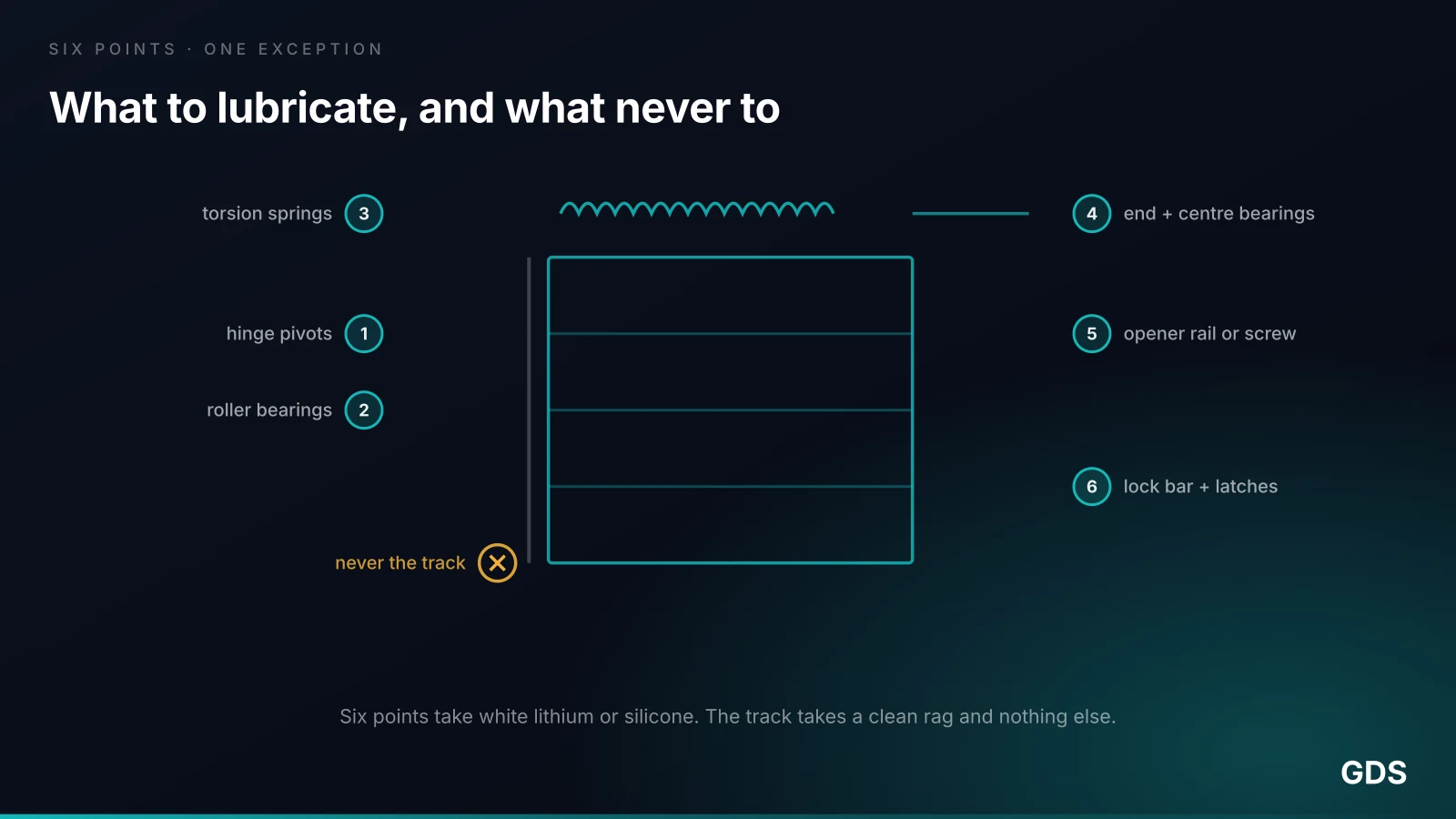
Lubricate a garage door with a garage-door-specific white lithium or silicone spray — never WD-40, which is a solvent that strips existing grease. Six points need it: the hinge pivots, the roller bearings (not nylon wheels), the torsion springs, the end and centre bearings, the opener rail or screw, and the lock bar. The tracks are never lubricated; they are wiped clean, because grease in a track collects grit and makes the door slide instead of roll. In Southwestern Ontario, do it twice a year — early autumn and spring — and take about ten minutes.
- WD-40 is a water-displacer and solvent, not a lubricant — it removes the grease a bearing needs.
- White lithium grease for metal-on-metal, silicone spray where rubber or nylon is involved.
- Never grease the tracks. Wipe them clean with a dry cloth or a rag and mild degreaser instead.
- Nylon roller wheels need nothing; only the bearing at the stem gets lubricant.
- Twice a year in Ontario — autumn before the freeze, spring after the salt season.
Use a garage door lubricant, not WD-40
This is the mistake behind most of the "I lubricated it and it got worse" calls we take. Standard WD-40 is a water-displacing solvent. It penetrates, it frees a seized fastener, and it evaporates — taking with it whatever grease was in the bearing you sprayed. A hinge treated with it is quiet for two days and then noisier than before, because you have washed the lubricant out.
What you want is one of two products. White lithium grease — in a spray can with a straw — is the right choice for metal-on-metal contact: hinge pivots, roller bearings, springs and bearing plates. It is thick enough to stay where you put it and it holds up in an unheated garage. Silicone spray is thinner and it is the right choice anywhere rubber or nylon is in contact, because lithium grease attacks some rubber compounds over time. Products sold specifically as "garage door lubricant" are generally a lithium or synthetic blend formulated for exactly this job, and they are worth the extra couple of dollars.
Two things to avoid outright: heavy grease applied with a brush, which collects grit and turns into grinding paste, and any oil thin enough to run — it will end up on your car and on the floor rather than in the bearing. Total cost for the right product is $10 to $20 a can, and one can lasts two or three years.
Step 1 — close the door, kill the power, clean the tracks
Close the door fully and unplug the opener or switch off its breaker. Everything that follows is done with the door down and stationary, which keeps your hands away from pinch points and puts every hinge within reach from a stepladder.
Now clean the tracks — and only clean them. Wipe the inside face of both vertical tracks with a dry cloth, or a rag with a little automotive brake cleaner or mild degreaser if there is caked grime. Track grooves accumulate dust, road salt and old grease, and that build-up is what makes rollers hop and chatter.
The tracks never get lubricant. A greased track makes the rollers slide rather than roll, which flat-spots steel rollers and grinds nylon ones, and the film traps every particle of grit that comes off the driveway. If somebody has greased yours in the past, cleaning them properly is genuinely the biggest single improvement you can make in this whole job.
Step 2 — hinges, rollers and the bearings inside them
Work along the door from the bottom joint up. Each hinge has a pivot barrel where the two leaves meet; a short burst of white lithium into that pivot is all it needs. Wipe the overspray off the painted panel face immediately — lithium grease will hold dust against the paint.
Rollers are where people over-apply. If your door has steel rollers, the target is the small bearing race at the base of the stem where it enters the roller — not the wheel surface that rides in the track. If your door has sealed nylon rollers, they need nothing at all: the bearing is sealed, and lubricant on a nylon wheel simply attracts grit. Spraying the wheel is another way people make a quiet door loud.
While you are along the door, look as much as you spray. Hinges with hairline cracks at the knuckle, roller stems that rock in their sleeves, and fasteners you can turn by hand are all things a ten-minute lubrication pass will show you. Any of the three is worth acting on before it becomes a hinge failure or a derailed door.
Hardware torqued, tracks aligned, spring tension set, safety systems calibrated — then everything lubricated. 17 points, one flat rate.
Step 3 — springs, bearing plates and the shaft
Above the door, coat the torsion springs along their full length with white lithium. This is not about making them work better — a spring does not have a bearing surface. It is about corrosion. A light film keeps moisture and salt-laden air off the steel, and rust between the coils is a genuine contributor to early spring failure in Ontario garages. Run the spray along the coil, then cycle the door once at the end of the job so the coils distribute it.
Then the bearings: the end bearing plates at each side of the opening and the centre bearing at the spring anchor bracket. Aim into the bearing race where the shaft passes through. These are the parts that squeal when they run dry, and they are also the parts nobody thinks to reach because they are above head height at the back of the header.
Do not touch the winding cones, the set screws or the cables. Nothing on a garage door needs you to loosen a fastener in order to lubricate it. If a spray straw does not reach it, it does not need spray.
Step 4 — the opener rail, and the lock bar people forget
The opener drive gets one of three treatments depending on its type. A chain drive gets a light coat of white lithium along the chain — it is a chain, and it wants grease. A screw drive gets lithium along the threads of the screw, which is the single most neglected maintenance item on that design and the reason old screw drives get loud. A belt drive gets nothing at all: the rubber belt should stay dry, and lubricant on it will make it slip and shorten its life. If you are not sure which you have, our guide to opener parts and drive types shows the differences.
The trolley — the carriage that runs along the rail and connects to the door arm — takes a light silicone spray on its rail contact surfaces on any drive type. So does the lock bar and its side latches if your door has them; those seize from disuse more often than from wear, and a seized lock bar that partially engages is a way to bend a panel.
Finish by plugging the opener back in, reconnecting the trolley, and running the door through two or three full cycles. Listen. A door that has been lubricated correctly gets noticeably quieter within a cycle or two. A door that sounds exactly the same has a mechanical problem that lubrication was never going to fix — worn rollers, failed bearings, or a balance issue.
How often, and what lubrication cannot fix
Twice a year is right for Southwestern Ontario, and the timing matters more than the frequency. Do it in early autumn, before the first hard freeze, so the door goes into winter with fresh grease that has not thickened and steel that is protected from salt-laden air. Do it again in spring, once the salt season is over, to displace what winter left behind. Doors that cycle more than six times a day, and commercial doors, want it quarterly.
Be clear about the limits. Lubrication reduces friction and prevents corrosion. It does not restore a collapsed roller bearing, straighten a bent track, re-tension a spring, or fix a door that has fallen out of balance. If a door is still loud, still slow, or still will not hold position after a proper lubrication pass, the noise was telling you about a part, not about dryness — our guide to what each sound means narrows it down.
It is also worth noting what lubrication is bundled into. A 17-point tune-up at $150 includes full lubrication as its last step, after the hardware has been torqued, the tracks aligned, the spring tension set and the safety systems calibrated — which is the order that actually matters. If you would rather have it done alongside everything else, we service London, Byron, Lambeth, White Oaks, St. Thomas and Strathroy.
Frequently asked questions
What is the best lubricant for a garage door?
A garage-door-specific white lithium grease spray for metal-on-metal points — hinge pivots, steel roller bearings, springs and bearing plates — and a silicone spray anywhere rubber or nylon is in contact. Both come in a can with a straw for $10 to $20, and one can lasts two or three years.
Can I use WD-40 on my garage door?
No. Standard WD-40 is a water-displacing solvent, not a lubricant: it penetrates and evaporates, taking the existing grease with it. A hinge sprayed with it goes quiet for a couple of days and then runs noisier than before. Use white lithium or silicone made for garage doors instead.
Should I lubricate garage door tracks?
Never. Grease in a track makes the rollers slide instead of roll, which flat-spots steel rollers and grinds nylon ones, and the film traps grit and road salt. Tracks get wiped clean with a dry cloth or a rag with mild degreaser — nothing else.
How often should I lubricate my garage door?
Twice a year in Southwestern Ontario: early autumn before the first hard freeze, and again in spring once the salt season ends. Doors cycling more than six times a day, and commercial doors, want it quarterly. The whole pass takes about ten minutes.
Do nylon garage door rollers need lubrication?
Sealed nylon rollers need nothing — the bearing is sealed and lubricant on the nylon wheel just attracts grit, which makes the door louder rather than quieter. On steel rollers, aim only at the small bearing race where the stem meets the wheel, never at the surface that rides in the track.
My garage door is still noisy after lubricating it. Why?
Because the noise was a part, not dryness. Lubrication cannot restore a collapsed roller bearing, a failed end bearing plate, a bent track or a door that has fallen out of balance. If a proper pass on the six points makes no difference, the next step is a diagnosis — the sound itself usually identifies which component has gone.
Related guides
Garage Door Tune-Up and Safety Inspection in London, ON: What’s Actually Included
What a real tune-up covers versus a five-minute "inspection", the 17 points we actually check, what it costs in London, and why fall is the right month to book it.
Noisy Garage Door? What Every Squeak, Grind and Bang Means
A healthy door is a quiet door. Squeal, grind, rattle, slap, bang — each sound points at a specific part. Here’s the diagnosis chart we use on service calls, and the 20-minute fix for most of it.
Garage Door Roller Replacement: Nylon vs Steel, and What It Costs
Ten small wheels carry the whole door. When their bearings give out the door gets loud, drags on the tracks and starts eating opener gears — here is how to read them and what replacing them costs.