
Overhead Door Repair and Installation in London, Ontario

An overhead door is any door that opens upward and stores overhead rather than swinging out — which covers almost every modern garage door. In practice the term describes three different systems: sectional doors (the standard residential type, panels on a curved track), rolling steel doors (a slat curtain coiling into a barrel, common on warehouses and storage units), and one-piece tilt-up doors (a single slab on pivot hinges, found on older London homes). Garage Door Solutions Inc. repairs and installs all three across London and the surrounding 50 km, with repairs from $149 and new installations from $1,499.
- "Overhead door" is a category and also a brand name — Overhead Door Corporation. Both usages are common.
- Sectional doors are the residential standard: panels, rollers, torsion springs, curved track.
- Rolling steel doors coil into a barrel above the opening and need different parts and different skills.
- One-piece tilt-up doors still exist on older London homes and swing outward as they open.
- We service every brand and every system — repairs from $149, new installs from $1,499.
"Overhead door" and "garage door" — the same thing, mostly
If you searched for overhead door repair and landed here, you are almost certainly in the right place. "Overhead door" describes how the door stores rather than what it is made of: it travels upward and parks overhead, instead of swinging out into the driveway the way a carriage or barn door does. Essentially every modern garage door is an overhead door.
There is one wrinkle worth knowing. Overhead Door Corporation is also a manufacturer — an American company that has been making doors since 1921, and whose name became a generic term the same way Kleenex did. So "I need my Overhead Door fixed" can mean "I have a door of that brand" or simply "I have a garage door". Either way, we service it: replacement springs, cables, rollers, seals and openers are sourced by specification, not by badge, and a brand-name door does not require a brand-name service company.
Where the distinction genuinely matters is in what system you have, because sectional, rolling steel and one-piece doors need different parts and different approaches. Telling us which one you have when you call means the right stock is on the truck.
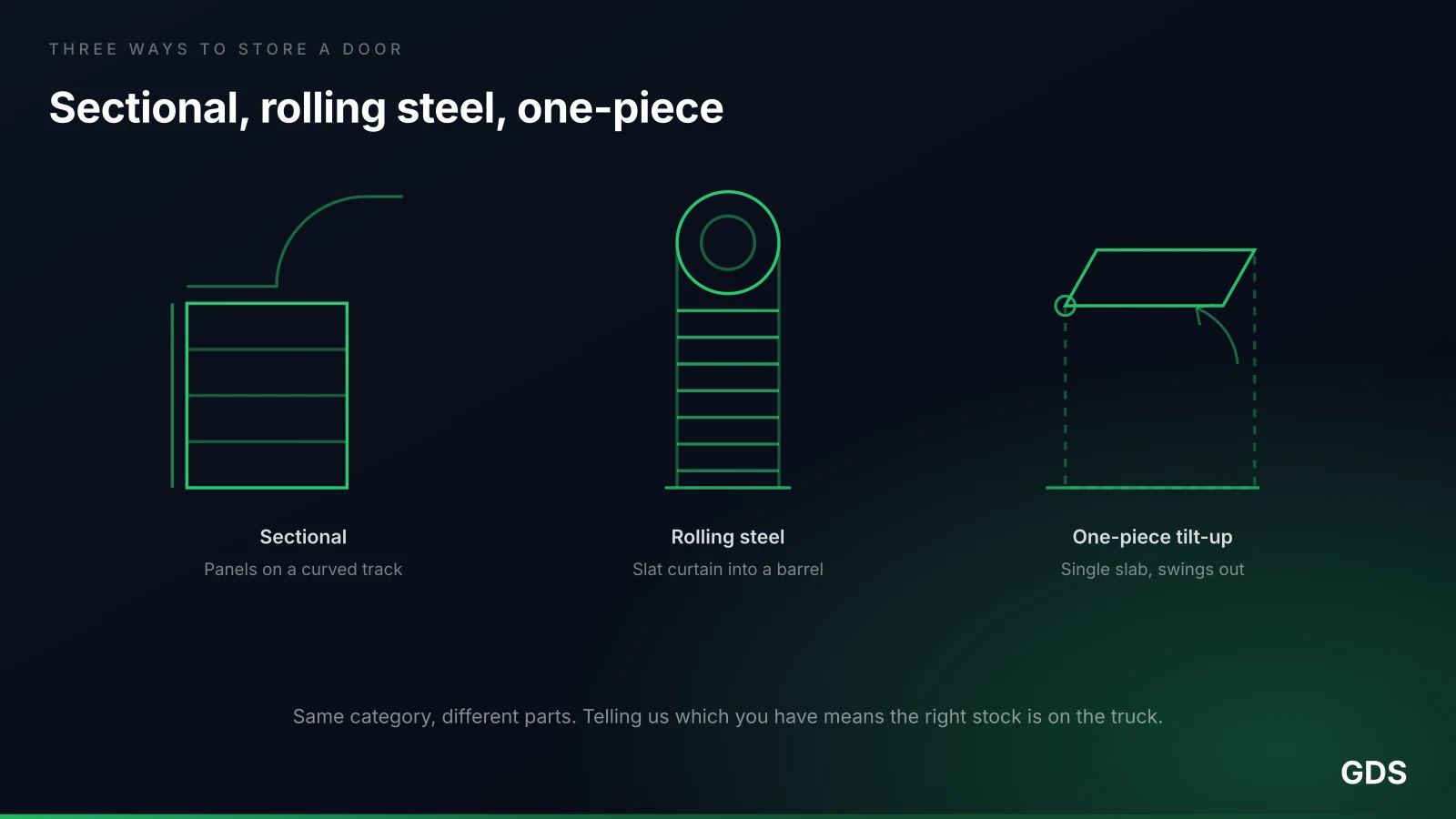
Sectional, rolling steel and one-piece: three overhead systems
Sectional doors are what almost every London home has. Three to five horizontal panels are joined by hinges, each carrying rollers that run in a track curving from vertical to horizontal along the ceiling. A torsion spring on a shaft above the opening counterbalances the weight. Everything in our guide to door types and installation applies to these.
Rolling steel doors — also called coiling or roll-up doors — replace the panels with narrow interlocking slats that curl around a barrel above the opening. There is no horizontal track and no ceiling clearance needed, which is why they dominate warehouses, loading docks, storage units and the back of retail units. They use a counterbalance spring inside the barrel rather than an exposed torsion shaft, and their common failures are different: bottom bar damage from forklifts, curtain slats bent out of the guides, and barrel spring tension loss. These are the doors behind most of our warehouse repair calls.
One-piece tilt-up doors are the oldest of the three and still turn up on London homes built before the 1970s. The whole door is a single slab on pivot hinges that swings outward and up as it opens, usually counterbalanced by extension springs on each side. They need clearance in front of the door as they open, which is why they were abandoned for short driveways, and parts for them are increasingly specialty items. When one of these fails badly, conversion to a sectional door is usually the better spend.
The repairs that come up most on overhead doors
On sectional doors the ranking is consistent year after year. Broken torsion springs lead by a wide margin, especially after the first hard freeze — that is a same-day spring replacement from $229, done in matched pairs. Frayed or snapped lift cables and doors that have jumped their track come next, at $179 and up. Opener faults — a dead logic board, a stripped gear, misaligned photo-eye sensors — are third, from $189. Worn rollers, cracked hinges and split bottom seals fill out the list.
On rolling steel doors the pattern shifts toward impact damage. A bottom bar bent by a forklift or a truck, slats pushed out of the side guides, and a curtain that no longer coils evenly are the calls we get most from London’s industrial parks. Barrel spring service on a rolling door is specialist work — the spring is inside the barrel, and the tension is set through an adjusting wheel rather than winding cones.
On one-piece doors, the extension springs and their pivot hardware are the usual culprits, and the safety consideration is sharper: extension springs without containment cables can travel across a garage when they break. If you have a tilt-up door with bare extension springs, adding safety cables is inexpensive and worth doing regardless of anything else.
Sectional, rolling steel or one-piece tilt-up — repairs from $149, new doors from $1,499, across London and 50 km.
Commercial overhead doors: cycle ratings and downtime
The specification that separates a commercial overhead door from a residential one is cycle rating. A standard residential torsion spring is rated for roughly 10,000 cycles — fine for a household opening the door four times a day. A shipping bay doing 40 cycles a day burns through that in under a year. Commercial doors are specified with high-cycle springs at 25,000, 50,000 or 100,000 cycles, and heavier gauge hardware to match.
Getting that specification wrong is the most expensive mistake in commercial door buying, because the cost is not the spring — it is the downtime when the bay is out of service. Our guide to heavy-duty commercial installation covers how to size cycle ratings to actual traffic, and scheduled commercial maintenance is what keeps a rated door reaching its rating.
For businesses, the other half of the equation is response. We run 24/7 emergency service from $149 at the same flat rate day or night, with no after-hours surcharge and no travel fee inside 50 km, and most calls in London proper are reached within 45 minutes and across the wider service area within 90 minutes. A bay that is down at 6 a.m. does not need a quote on Monday.
Overhead door installation: what the job actually involves
A residential sectional installation starts with a free in-home measure, because the numbers that matter are not the door size. Headroom — the space between the top of the opening and the ceiling — determines whether a standard torsion setup fits or whether you need a low-headroom track or a wall-mount jackshaft opener. Backroom, sideroom and the position of any obstructions do the rest. Ordering a door without those measurements is how installs get delayed.
On the day, the old door and track come out, the new track and springs are fitted to the opening, the panels go up one at a time, the springs are wound to the calculated turn count for the door’s weight, and the opener is fitted or refitted with its travel limits and force settings tuned to the new door. Old-door removal and disposal are included. Most single-door residential installs are a half-day; a double door or an install that also needs a new opener runs longer. The full picture is in our installation buyer’s guide.
Two decisions do most of the work on the final price: insulation and glazing. In this climate an insulated door is worth it on any attached or heated garage, and windows are consistently the easiest line to trim if a quote needs to come down. What a new door costs across the range is broken out in our London pricing guide.
What overhead door repair and installation cost in London
Repairs start at $149 for the diagnostic plus repair and are quoted as one all-in price before work begins. Springs are from $229, cable and track work from $179, opener repair from $189, and a 17-point tune-up is $150. New residential installation starts at $1,499 including old-door removal, and rises with size, material, insulation R-value and glazing. Every repair and install carries a 1-year warranty on parts and labour. The full cost picture across repair types is in our repair cost guide.
Commercial and rolling steel work is quoted per door after a site visit, because cycle rating, opening size, guide condition and operator type move the number too much for a list price to be honest. What does not change is the pricing structure: one all-in figure confirmed before work starts, and no after-hours multiplier.
We repair and install overhead doors of every brand across London and the surrounding 50 km — including London, Byron, Hyde Park, Masonville, Lambeth, St. Thomas, Strathroy, Woodstock and Ingersoll. Garage Door Solutions Inc. is locally owned, licensed and insured, and you can read what customers say before you book.
Frequently asked questions
Is an overhead door the same as a garage door?
Almost always, yes. "Overhead door" describes how the door stores — travelling upward and parking overhead rather than swinging out — which covers essentially every modern garage door. It is also a brand name, Overhead Door Corporation, so the phrase can mean either the category or that manufacturer. We service both.
Do you repair Overhead Door brand garage doors?
Yes. We service every brand, including Overhead Door, Clopay, Wayne Dalton, Garaga, Richards-Wilcox and Amarr. Springs, cables, rollers, seals and openers are sourced by specification — wire size, drum type, track radius — not by badge, so a brand-name door does not require a brand-name service company.
What are the three types of overhead door?
Sectional doors (horizontal panels on a curved track with a torsion spring — the residential standard), rolling steel doors (interlocking slats coiling into a barrel above the opening, common on warehouses and storage units), and one-piece tilt-up doors (a single slab on pivot hinges that swings outward as it opens, found on older homes).
How much does overhead door repair cost in London, Ontario?
Repairs start at $149 for the diagnostic plus repair, quoted as one all-in price before work begins. Springs are from $229, cable and track work from $179, opener repair from $189, and a 17-point tune-up is $150. Every repair carries a 1-year warranty on parts and labour, with no after-hours surcharge.
How much does a new overhead door cost installed?
New residential installation starts at $1,499 including removal and disposal of the old door, and rises with size, material, insulation R-value and glazing. Commercial and rolling steel doors are quoted per door after a site visit, because cycle rating, opening size and operator type move the number too much for a list price.
Can you replace a one-piece tilt-up door with a sectional?
Usually, yes, and it is often the better spend once a tilt-up door needs significant work. The conversion means new track, a torsion setup and a sectional door sized to the opening, and it removes the tilt-up’s two drawbacks — the swing-out clearance it needs in front and its increasingly hard-to-source parts. We measure headroom and sideroom first to confirm it fits.
Related guides
The Ultimate Guide to Garage Doors: Types, Styles & Installation
Materials, styles, insulation, and the install process — the one guide to choosing a new garage door, start to finish.
Warehouse Garage Door Repair in London, ON: Rapid Response
A jammed warehouse or dock door stops the whole operation. The common heavy-use failures, how rapid-response repair works in London, and how to avoid downtime.
New Garage Door Installation in London, Ontario: A Buyer’s Guide
What a new garage door install actually involves in London — the free measure, choosing material and insulation, the install day, and what to expect on price.