
Garage Door Bottom Seal and Weather Seal Replacement in London

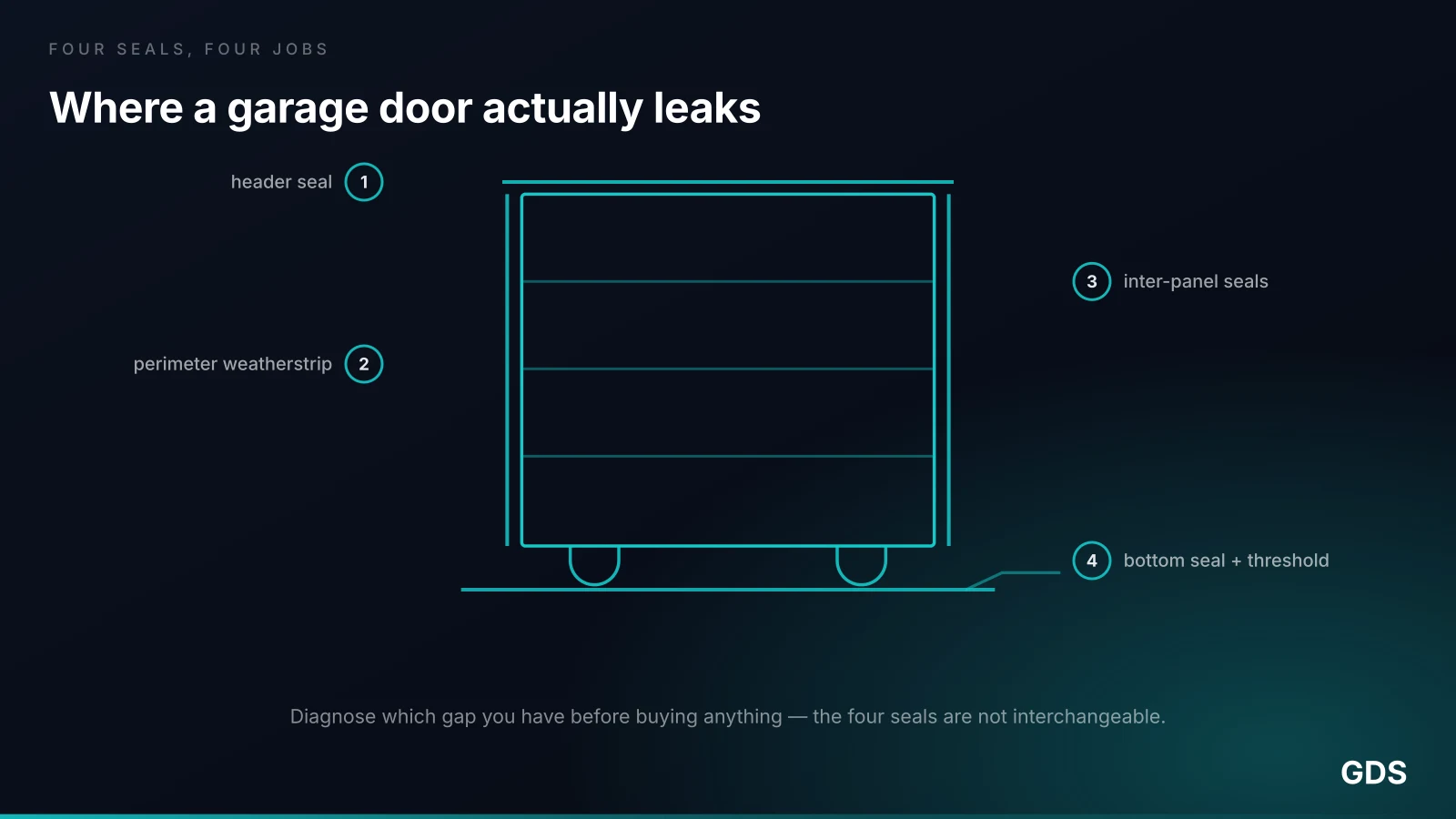
A garage door has four separate seals: the bottom seal (astragal) in the retainer under the lowest panel, the perimeter stop-moulding weatherstrip down both jambs and across the header, the inter-panel seals between sections, and on some doors a threshold seal bonded to the floor. The bottom seal fails first — EPDM rubber goes hard and splits after 5 to 10 Ontario winters. Replacement is straightforward if you match the profile to your retainer: T-style, bulb, or beaded. In London, Ontario a fitted bottom seal runs $149 to $249 depending on door width, or $30 to $80 as an add-on to a $150 tune-up.
- Four seals, four jobs — diagnose which gap you actually have before buying anything.
- Bottom seals are matched to the retainer profile: T-style, bulb, or beaded. They are not interchangeable.
- EPDM rubber stays flexible to about −40 °C; cheap vinyl goes rigid and cracks in a London January.
- A bottom seal that has frozen to the slab is the leading cause of stripped opener gears in winter.
- An uneven gap across a closed door is not a seal problem — it is usually a balance or track issue.
Four seals, four different jobs
People say "weather seal" and mean any of four parts. Getting the name right is what stops you buying the wrong one.
The bottom seal — the trade calls it an astragal — is the flexible strip held in an aluminium retainer along the underside of the bottom panel. It is the only seal that gets compressed against the concrete on every cycle, so it wears fastest and it is what most people are looking for.
The perimeter weatherstrip is the flap on the stop moulding down both sides of the opening and across the header. It seals the gap between the door face and the jamb. On most London homes it is vinyl-flanged, nailed into a wood stop, and it fails by going brittle and splitting at the nail line — usually on the south-facing side first, because UV does the damage.
The inter-panel seals are the moulded lips built into the top and bottom edges of each section, which meet as the door closes. They are part of the panel, not a replaceable strip, and if they have failed the door itself is usually past its service life. Finally, threshold seals are a rubber ramp bonded to the garage floor with adhesive — an add-on for sloped driveways or floors that have settled, not standard equipment.
How to tell which seal has failed
Close the door on a bright day, stand inside with the lights off, and look at the perimeter. Light is the diagnostic. A thin even line of light along the floor means the bottom seal has compressed flat or split. Light down one jamb but not the other points to the stop-moulding weatherstrip on that side, or to a jamb that has moved. Light along the top edge means the header weatherstrip, or a door whose tracks have drifted so the door no longer seats squarely against the stop.
The important distinction is even versus uneven. A uniform gap across the whole width is a seal problem, and a new astragal fixes it. A wedge-shaped gap — tight at one end, wide at the other — is not a seal problem at all. That is a door sitting crooked, which points at a balance issue, a slipping cable drum, or an unlevel floor. Fitting a thicker seal to hide a wedge gap works for one season and then makes the door bind on the tight side.
The other everyday tell is behavioural. Mice, drifted snow along the inside of the door line, and leaves in the garage after a windy night all say the bottom seal is done. So does a door that freezes to the slab in January — the seal has lost its flex, water pools in the deformed profile, and it bonds to the concrete overnight.
Bottom seal profiles: match the retainer, not the picture
Bottom seals are sold by the shape of the bead that slides into the retainer, and the shapes are not interchangeable. Look at the end of the aluminium retainer under your door and you will see the channel profile in cross-section.
A double-channel retainer with two parallel slots takes a T-style seal — a strip with two T-shaped ribs on top. This is the most common residential fitting in Canada and the one most people have. A single round channel takes a bulb seal, which hangs as a large hollow tube and is the better choice where the floor is uneven, because the bulb can deform further before it stops sealing. A single flat channel with a lipped opening takes a beaded (or J-type) seal.
Material matters as much as profile in this climate. EPDM rubber stays flexible down to roughly −40 °C. Cheap PVC and vinyl seals stiffen well above that, and a rigid seal does not seal — it also becomes the part that shatters when the opener drags a frozen door. Whatever you fit, fit EPDM. Also measure the door width and buy long: a 16-foot double door needs a seal cut from a longer piece, and a seal spliced in the middle leaks at the splice.
EPDM bottom seal matched to your retainer, perimeter weatherstrip checked, and the door rebalanced so it seats square on the slab.
Replacing the seals: what is DIY and what is not
A bottom seal is one of the few garage door repairs that is genuinely homeowner-friendly, with the door fully closed and the opener unplugged. The old seal slides out of the retainer end-on — soapy water on the new one helps it feed through — and the new strip is drawn in the same way. The awkward part is that a 16-foot strip fights you, so it is a two-person job, and retainer ends that have been crimped over need opening with pliers first.
Perimeter weatherstrip is also approachable: it is nailed or screwed to the wooden stop moulding, and it comes off with a pry bar. The trap is over-compression. The flap should just kiss the closed door, not press hard against it. Weatherstrip nailed too tight is a common cause of a door that struggles to open on a cold morning, because the vinyl has effectively glued itself to the door face.
Two cases are not DIY. If the aluminium retainer itself is bent, corroded through, or has torn away from the panel, replacing it means working at the bottom panel where the bottom brackets and lift cables are anchored — that is spring-tension territory. And if the gap is wedge-shaped rather than even, fix the cause first; a seal is not the repair.
What seal replacement costs in London, Ontario
A fitted bottom seal in London and the surrounding 50 km runs $149 to $249, parts and labour, with a 1-year warranty. Door width is the main variable — a 16-foot double door needs roughly twice the material of a single — and a retainer that also needs replacing sits at the top of that band. Perimeter weatherstrip for a full opening runs $149 to $229 fitted. Added to a $150 tune-up, a bottom seal typically adds $30 to $80, which is the cheapest way to buy one because the technician is already there and the door is already being balanced.
The payback is not really about heat. On an attached garage a good seal set measurably cuts draught into the house, and it is a sensible companion to an insulated door — but the bigger return is mechanical. A seal that has gone rigid is the leading cause of a door freezing to the slab, and a frozen door that an opener tries to lift is how chain-drive gear sets strip. That repair starts at $189, and it is entirely avoidable.
Best time to do it: early autumn, before the first hard freeze, alongside the rest of your winter prep. We fit seals across London, Byron, White Oaks, Old North, Strathroy and St. Thomas.
Frequently asked questions
How much does garage door bottom seal replacement cost in London, Ontario?
A fitted bottom seal runs $149 to $249 with parts, labour and a 1-year warranty, with door width the main variable. Added to a $150 tune-up it typically costs $30 to $80 extra, because the technician is already on site and the door is being balanced anyway. Perimeter weatherstrip for a full opening is $149 to $229 fitted.
How do I know which garage door bottom seal to buy?
Match the bead profile to your aluminium retainer, not to a photo. A double-channel retainer with two parallel slots takes a T-style seal; a single round channel takes a bulb seal; a single lipped flat channel takes a beaded or J-type. Buy EPDM rubber rather than PVC — EPDM stays flexible to about −40 °C, vinyl goes rigid and cracks.
Why is there a gap under my closed garage door?
An even gap across the full width means the bottom seal has compressed flat or split, and a new astragal fixes it. A wedge-shaped gap — tight at one end, wide at the other — is not a seal problem: the door is sitting crooked, usually from a balance issue, a slipping cable drum, or a settled floor. Fitting a thicker seal to hide a wedge gap makes the door bind.
Can I replace a garage door bottom seal myself?
Yes, in most cases. With the door closed and the opener unplugged, the old seal slides out of the retainer end-on and the new one feeds in the same way — soapy water helps, and a 16-foot strip is a two-person job. What is not DIY is replacing a bent or corroded retainer, because that means working at the bottom panel where the lift cables anchor under spring tension.
How long does a garage door bottom seal last?
Five to ten Ontario winters for a good EPDM seal, less for cheap vinyl. Freeze-thaw cycles, road salt and UV on the exposed edge all shorten it. Replace it when it no longer springs back after the door opens, when it has visible splits, or the first winter it freezes to the slab.
Will a new weather seal stop my garage from being cold?
It stops the draughts, the drifted snow and the mice, and on an attached garage it noticeably cuts what leaks into the house — but a seal is not insulation. If the garage itself is cold, seals plus an insulated door are the pair that works. The bigger practical win from a good seal is mechanical: it keeps the door from freezing to the slab, which is what strips opener gears in January.
Related guides
How to Winterize Your Garage Door for an Ontario Winter
Frozen seals and brittle springs make winter the busiest season for breakdowns — here’s how to winterize your door before the cold hits.
Why Won’t My Garage Door Open in the Cold? 7 Winter Fixes
Frozen to the floor, opener straining, spring snapped on the first cold snap — the seven things that stop a garage door in an Ontario winter, and which you can fix yourself.
Are Insulated Garage Doors Worth It in Ontario? R-Value, Comfort & Cost
An uninsulated steel door is a radiator pointed the wrong way in January. What R-12 vs R-18 really buys you, why the thermal break matters more than the sticker, and who can safely skip it.